
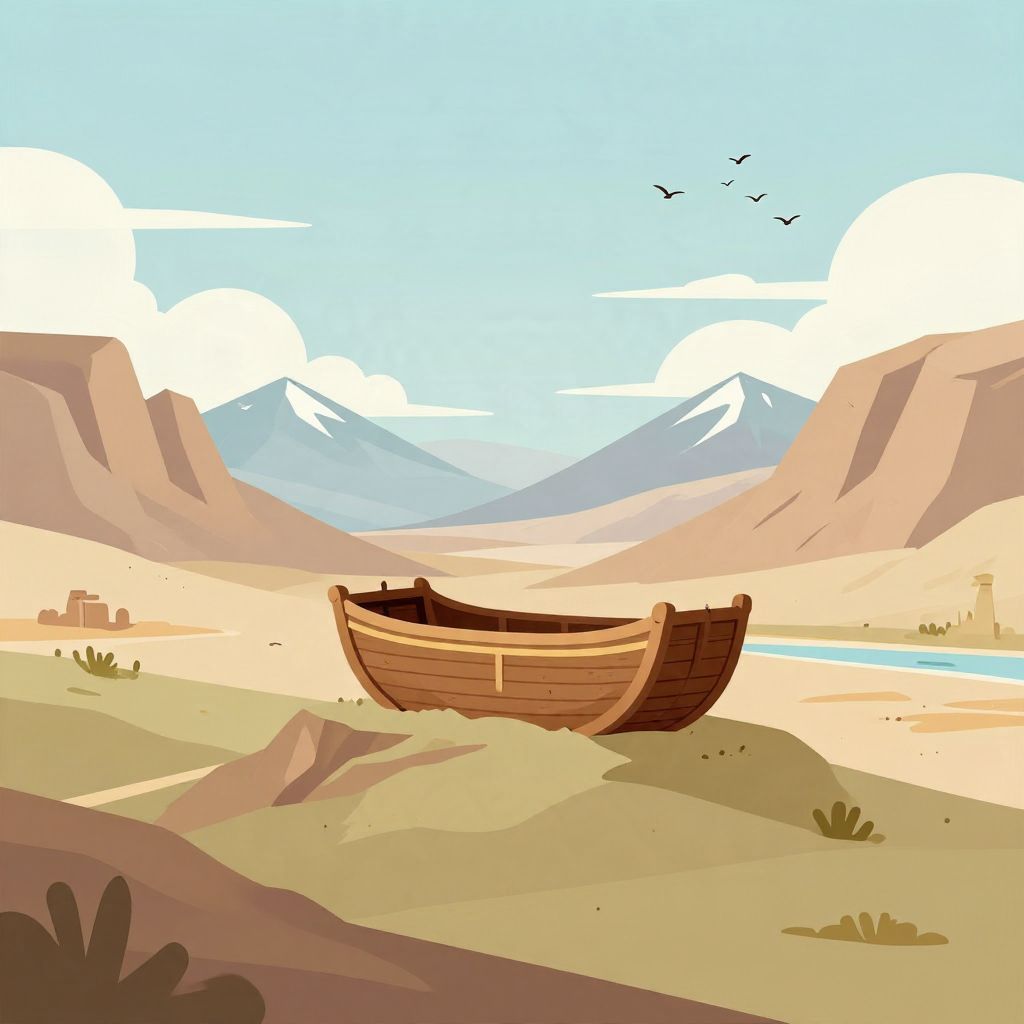
Where did Noah’s Ark land? The short answer is that, in the biblical tradition, the Ark came to rest on the “mountains of Ararat,” a phrase found in the Book of Genesis. Over time, many readers have identified this with the volcanic massif of Mount Ararat in eastern Turkey, but the text itself does not name a single peak.
Because the story sits at the crossroads of scripture, geography, and legend, the answer depends on whether one is asking about the Bible’s wording, later religious tradition, or modern attempts to locate the Ark historically.
Where did Noah’s Ark land?
According to Genesis 8:4, the Ark “rested upon the mountains of Ararat” after the floodwaters receded. This is the earliest and most important source for the location. The phrase refers to a region or highland area, not necessarily the modern mountain called Mount Ararat, though that mountain became the most famous identification in later tradition.
The biblical text and what it actually says
“Mountains of Ararat,” not a single named summit
The Hebrew Bible does not say that the Ark landed on “Mount Ararat” in the modern sense. It says the Ark rested on the “mountains of Ararat.” That wording matters. In ancient texts, “Ararat” is generally understood as a place-name or territorial designation, not a precise GPS-style coordinate. In other words, the source points to a mountainous region rather than a specific peak.
Why translation matters
Later readers often collapsed the phrase into one mountain because that is easier to picture. But the original wording leaves room for interpretation. The Bible’s account is theological and narrative in purpose; it is not written as a modern expedition report. As a result, the location is best understood as part of a sacred story rather than a fully documented historical event.
What was Ararat in the ancient world?
Ararat and the kingdom of Urartu
Most scholars connect the biblical “Ararat” with Urartu, an Iron Age kingdom centered around the highlands of eastern Anatolia, near modern-day Turkey, Armenia, and northwestern Iran. In Assyrian sources, Urartu was a real political entity, and “Ararat” likely reflects the same broad region through Hebrew tradition. This helps explain why the Ark is placed in the mountains of that area.
A highland landscape in the ancient Near East
The Ararat/Urartu region was known for rugged mountains, snow, and difficult terrain. In ancient imagination, such a place naturally suited a flood story: the waters recede, and the vessel comes to rest on a remote highland. The setting also fits the broader geography of the ancient Near East, where mountain ranges often symbolized distance, survival, and divine encounter.
Why Mount Ararat became the famous answer
The rise of a specific identification
Although the biblical text does not name Mount Ararat directly, later Jewish, Christian, and Islamic traditions increasingly associated the Ark with the prominent volcanic mountain now called Mount Ararat. Its dramatic height and visibility made it a compelling candidate. Over time, this popular identification became so widespread that many people assume it is the Bible’s exact wording.
The mountain’s symbolic power
Mount Ararat stands out in the landscape of eastern Turkey and has long carried cultural meaning. For Armenians especially, it became a powerful national and religious symbol, even though the mountain lies within modern Turkey. Its prominence in art, literature, and devotion helped cement the idea that this was the Ark’s resting place.
Historical background of the Ark tradition
The flood story in a wider ancient context
Noah’s Ark belongs to a broader ancient Near Eastern tradition of flood narratives. Similar stories appear in Mesopotamian literature, including the Epic of Gilgamesh and the Atrahasis Epic. These texts also feature a divinely warned survivor, a boat, a flood, and a landing on a mountain. The biblical version is distinct in its theology, but it shares motifs with older regional stories.
What that means for the location question
Because flood traditions circulated across the ancient Near East, the Ark’s landing place should be read as part of a literary and religious world, not as an independently verified archaeological site. The mountain location gives the story a believable geographical anchor, but it does not by itself prove a recoverable historical event.
Did the Ark land on the modern Mount Ararat?
Scholarship and uncertainty
Many people use “Mount Ararat” as shorthand for the biblical location, but historians and biblical scholars usually distinguish between the ancient term “Ararat” and the modern mountain. The identification is plausible as a tradition, yet it is not certain. The Bible does not provide enough detail to confirm the exact summit or even the exact mountain range with complete confidence.
Why certainty is difficult
Several factors make certainty unlikely:
- The text is ancient and brief.
- The place-name may refer to a region rather than a single mountain.
- Later traditions developed after the original composition.
- No universally accepted archaeological evidence has established the Ark’s location.
For these reasons, the strongest historical answer is that the Ark was said to have rested in the mountains associated with Ararat/Urartu, later linked by tradition to Mount Ararat.
How later traditions shaped the story
Jewish, Christian, and Islamic interpretations
Across the Abrahamic traditions, Noah’s Ark remained a powerful symbol of survival, covenant, and divine mercy. Jewish and Christian interpreters often read the Ararat reference geographically, while Islamic tradition also honors Noah and the flood narrative, though the Qur’an does not preserve the same landing-place wording in identical form. Over centuries, devotion and commentary reinforced the mountain association.
Pilgrimage, curiosity, and exploration
From medieval times onward, travelers and explorers tried to identify the Ark’s resting place. Some claimed to have seen remains on Mount Ararat or nearby peaks, but such reports are difficult to verify and often reflect local legend, religious enthusiasm, or mistaken observation. The mountain’s fame inspired repeated searches, especially in the modern era, but no claim has achieved broad scholarly acceptance.
Archaeology, legend, and modern claims
What archaeology can and cannot do
Archaeology can illuminate the cultures that produced the flood traditions, but it has not produced a universally accepted Ark discovery. The high, glaciated terrain around Mount Ararat is difficult to survey, and many reported findings have not stood up to rigorous testing. That does not mean the tradition is meaningless; it means the story belongs to the realm of religious memory more than confirmed material history.
Why the search continues
The Ark remains compelling because it combines catastrophe, survival, and hope. For believers, the landing place is tied to divine preservation. For historians, it is a case study in how sacred narratives connect text, landscape, and identity. For the public, it is one of the most famous unresolved location questions in biblical history.
So where did Noah’s Ark land, in historical terms?
Historically speaking, the best-supported answer is this: the Ark was said in Genesis to have come to rest on the “mountains of Ararat,” a highland region associated with ancient Urartu in eastern Anatolia. The modern Mount Ararat is the most common later identification, but it is an interpretation rather than a certainty established by the biblical text itself.
That distinction is important. The story preserves a sacred geography, not a precise archaeological address. Its enduring power comes from that blend of memory, landscape, and faith. If you want to explore the geography behind the tradition further, see where the Ark is thought to be located and the wider ancient setting in where Canaan was.