
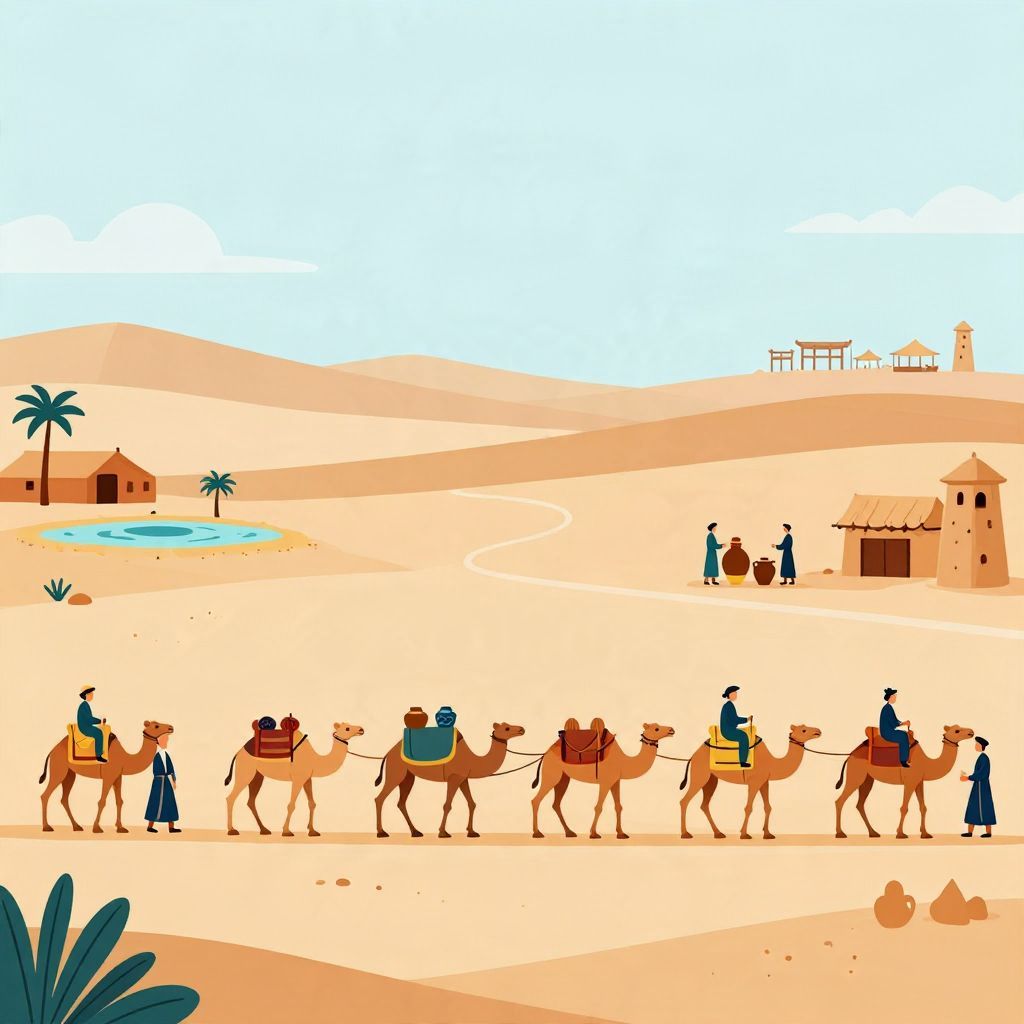
The Silk Road was important because it connected distant societies across Asia, the Middle East, Africa, and Europe, making long-distance trade, cultural exchange, and the movement of ideas possible on an unprecedented scale. It was not a single road but a network of routes that helped shape the ancient and medieval world.
Its significance went far beyond luxury goods like silk. The Silk Road carried religions, technologies, artistic styles, disease, diplomatic contacts, and knowledge between empires and communities that might otherwise have remained isolated from one another.
Why Was The Silk Road Important?
The Silk Road was important because it linked economies and cultures across Eurasia from roughly the second century BCE to the fifteenth century CE. It enabled trade in high-value goods, spread religions and technologies, and created lasting connections between China, Central Asia, India, the Middle East, and Europe.
It connected distant economies
The most immediate reason the Silk Road mattered was commerce. Merchants moved silk, spices, horses, precious metals, glass, textiles, ceramics, and other valuable goods across thousands of miles. Because overland transport was slow and risky, the route favored compact, expensive items rather than bulk commodities. Even so, the trade was economically significant because it tied together regions with different resources and demands.
China was especially famous for silk production, which gave the network its modern name, although silk was only one of many traded products. In return, Chinese markets received horses from Central Asia, while the Roman world and later Islamic states sought Asian luxury goods. This exchange encouraged specialized production, stimulated urban markets, and enriched merchants, middlemen, and states that taxed trade.
It spread ideas, religions, and beliefs
The Silk Road was not only a commercial system; it was also a cultural highway. Buddhism spread from India into Central Asia and China along these routes, carried by monks, pilgrims, and merchants. Later, Islam expanded across large parts of Central Asia and into western China and Southeast Asia through a combination of conquest, trade, migration, and scholarly exchange. Christianity, especially in its eastern forms, also traveled along these networks.
Religions changed as they moved. Local traditions blended with imported beliefs, creating new artistic forms, ritual practices, and philosophical interpretations. This process is one reason historians see the Silk Road as a zone of cultural interaction rather than a simple line of transmission. It helped produce the religious diversity of Eurasia and shaped the development of monasteries, shrines, and learning centers along the route.
It moved technologies and practical knowledge
Important technologies and techniques also traveled along Silk Road routes. Papermaking, which originated in China, eventually spread westward and transformed record-keeping, administration, scholarship, and book production across the Islamic world and later Europe. Printing techniques, methods of textile production, metalworking skills, and agricultural knowledge also moved across regions over time.
Not every invention traveled in a straight line, and not every innovation can be traced to a single route. Still, the Silk Road made cross-cultural transmission more likely by bringing traders, artisans, diplomats, and travelers into sustained contact. Practical knowledge often moved alongside goods, whether in the form of craft techniques, medical ideas, or navigational information.
It encouraged diplomacy and empire-building
States understood the value of controlling trade routes. Empires such as the Han, Kushan, Parthian, Sasanian, Tang, and Mongol states all played roles in shaping the security and taxation of Silk Road traffic. Some sought to protect merchants, while others tried to monopolize trade or use it to strengthen political influence.
Diplomatic missions often traveled along the same corridors as merchants. Rulers exchanged gifts, sought alliances, and gathered intelligence. Control of oasis towns, mountain passes, and caravan hubs could bring wealth and strategic advantage. In this sense, the Silk Road was important not only for private trade but also for state power and international politics.
It linked urban centers and frontier societies
The Silk Road helped cities grow. Trade encouraged the rise of oasis towns and commercial centers such as Samarkand, Bukhara, Kashgar, Merv, and Dunhuang. These places became meeting points for languages, religions, and goods from many regions. Caravans needed food, shelter, animals, guides, and warehouses, which supported local economies and urban life.
At the same time, the Silk Road was shaped by frontier societies, nomadic groups, and pastoral peoples who often played crucial roles as intermediaries, protectors, or competitors. The network was never controlled by one civilization alone. Its history reflects cooperation, rivalry, and adaptation among many different peoples.
How the Silk Road Developed Over Time
The Silk Road emerged gradually, rather than being created at one moment. Overland exchange across Eurasia existed long before the famous imperial routes, but the network expanded significantly when Chinese states, Central Asian intermediaries, and western empires became more deeply connected. Its peak importance came in different periods depending on the region, especially under the Han dynasty, the Tang dynasty, and the Mongol Empire.
Early expansion under the Han dynasty
Chinese interest in western trade increased after the diplomatic missions of Zhang Qian in the second century BCE. His journeys helped the Han court learn more about Central Asia and encouraged contact with regions beyond China’s traditional frontier. From then on, overland routes through the Tarim Basin and beyond became more systematically used.
These routes were difficult and dangerous. Travelers crossed deserts, mountains, and politically fragmented territories. Yet the potential rewards were high. Han rulers wanted horses and other goods, while Central Asian and western traders wanted access to Chinese silk and manufactured products. This mutual demand helped sustain the network.
Growth during the classical and medieval periods
From late antiquity through the early medieval period, the Silk Road remained important because several large states helped stabilize sections of it. The Kushan Empire linked South and Central Asia, while Persian powers connected eastern and western trade zones. Later, the Tang dynasty fostered a cosmopolitan environment in which merchants, monks, and envoys from many lands moved through Chinese territory.
During this era, maritime trade also grew. The Silk Road was therefore part of a wider Eurasian exchange system that included sea routes through the Indian Ocean. Historians often emphasize that “Silk Road” is a modern label for a flexible and changing network, not a single fixed highway. Its importance lay in the connections it created, not in one roadbed.
The Mongol era and wider integration
The thirteenth and fourteenth centuries saw a major phase of Eurasian integration under the Mongol Empire. Mongol rule across much of the continent reduced some barriers to travel and made long-distance movement safer in certain areas. Merchants, envoys, missionaries, and travelers such as Marco Polo moved across this connected world, though travel still remained difficult and dangerous.
This period intensified exchange in goods, knowledge, and disease. The same networks that carried commercial and cultural traffic also helped spread the Black Death in the mid-fourteenth century. That tragic consequence is part of the Silk Road’s history too: the route’s power to connect societies made it valuable, but it also made them vulnerable.
What Did the Silk Road Change?
The Silk Road changed history by making Eurasia more interconnected. It did not erase local differences, but it created a world in which distant societies could influence one another more directly. The effects were economic, cultural, political, and demographic, and they continued long after the overland routes declined in importance.
It transformed trade patterns
Before large-scale interregional exchange, many societies relied mainly on local or regional markets. The Silk Road encouraged the growth of long-distance commercial systems and helped normalize the idea that goods could move across continents. This in turn supported merchant communities, credit arrangements, caravan infrastructure, and state taxation.
Trade also became more specialized. Different regions increasingly produced goods suited to their resources and skills, then exchanged them through intermediaries. This pattern did not make societies dependent in a modern industrial sense, but it did deepen economic interdependence across Eurasia.
It fostered cultural blending
Art and architecture along the Silk Road often show a mixture of influences. Motifs, styles, and techniques from Greece, Persia, India, China, and Central Asia could appear together in sculpture, painting, textiles, and religious art. This blending is visible in places such as the oasis cities and cave complexes of Central Asia, where multiple traditions met.
Language also reflected the route’s diversity. Traders and travelers used many tongues, and multilingual communities were common in commercial centers. Translation became an important profession, helping to move texts and ideas across cultural boundaries. The Silk Road therefore contributed to a more cosmopolitan Eurasian world.
It spread disease as well as goods
One of the most important historical consequences of the Silk Road was the spread of epidemic disease. The best-known example is the Black Death, which likely traveled through interconnected trade routes from Central Asia into the Mediterranean world in the fourteenth century. This was not unique to the Silk Road, but the route’s connectivity helped disease move faster and farther than it otherwise might have.
This darker side of exchange reminds us that historical networks are never purely beneficial. The same channels that carried wealth and knowledge also carried risk. That dual legacy is central to understanding why the Silk Road mattered so much.
Why the Silk Road Still Matters to Historians
Historians study the Silk Road because it reveals how connected the premodern world already was. It challenges the idea that ancient civilizations developed in isolation and shows instead that trade, migration, religion, and diplomacy shaped history across vast distances. The Silk Road also helps explain the rise of cities, empires, and cross-cultural societies.
At the same time, scholars caution against oversimplifying it. The phrase “Silk Road” can make the network seem more unified than it really was. In reality, it consisted of many routes, many peoples, and many historical phases. Its importance came from repeated interaction over centuries, not from a single fixed system.
In the end, the Silk Road was important because it connected worlds. It moved goods, but it also moved beliefs, technologies, and people, leaving a legacy that shaped Eurasian history for centuries. If you want to explore the broader economic and cultural changes behind this network, you may also be interested in what the Commercial Revolution was and how Islam spread.