
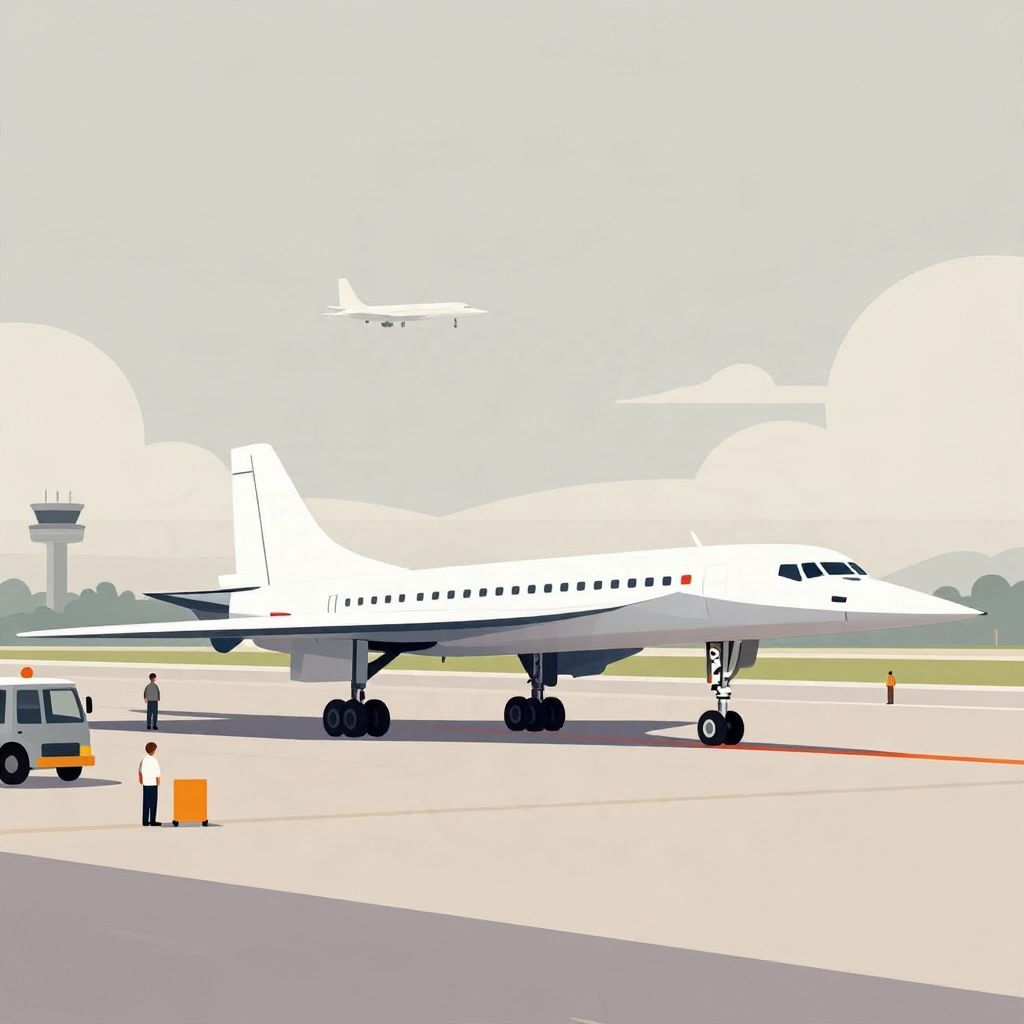
Why did the Concorde stop flying? The short answer is that it became too expensive, too noisy, and too limited to remain commercially viable, and then a fatal crash in 2000 shattered confidence in the aircraft. After the September 11 attacks further weakened air travel, British Airways and Air France retired the Concorde in 2003.
The Concorde was not forced out by one single cause. It was a remarkable technological achievement, but one that belonged to a narrow economic and political moment in aviation history. Its end came from a combination of high operating costs, environmental restrictions, limited routes, aging airframes, and changing public expectations about safety and travel.
Why did the Concorde stop flying?
The Concorde stopped flying because it was no longer commercially sustainable. Only a small number of passengers could afford its premium fares, while fuel use, maintenance, and airport restrictions made it costly to operate. After the 2000 Air France crash and the post-9/11 downturn in air travel, the aircraft’s future became untenable.
The Concorde’s promise and its limits
Concorde was the Anglo-French supersonic passenger jet that entered service in 1976, designed to cross the Atlantic at more than twice the speed of sound. It was a symbol of modernity and prestige, but from the beginning it faced a basic problem: speed was impressive, yet the market for expensive supersonic travel was tiny.
A technological triumph with a narrow business case
The aircraft could fly from London or Paris to New York in about three and a half hours in the air, cutting travel time dramatically. But Concorde seats were expensive to build, expensive to maintain, and expensive to fill. Its cabin was small by airliner standards, and its range was limited compared with conventional long-haul jets.
That meant Concorde was never a mass-market aircraft. It served a wealthy clientele, business travelers, celebrities, and special occasions. Even at its best, it depended on prestige and exclusivity rather than scale. That made it vulnerable when operating costs rose or demand weakened.
The main reasons Concorde stopped flying
1. It was too expensive to operate profitably
Concorde used large amounts of fuel and required highly specialized maintenance. Its engines, structure, and systems were far more complex than those of subsonic airliners. Because it carried relatively few passengers, the cost per seat was very high. Airlines could charge premium fares, but not enough to make the aircraft broadly profitable in the long run.
In practical terms, Concorde worked best as a prestige product for a few routes, especially transatlantic service. It was not flexible enough to be redeployed widely, and it could not compete with larger, more efficient jets that carried far more passengers at lower cost.
2. Sonic booms and noise restricted where it could fly
Supersonic flight produces sonic booms, which are disruptive on the ground. As a result, Concorde could not fly supersonically over land in most places. That severely limited its route network and made it far less useful than a conventional jet that could fly fast anywhere.
It also generated significant engine noise, especially during takeoff. Airports and local communities increasingly resisted such aircraft as environmental regulation and noise standards became stricter in the late 20th century. These restrictions did not kill Concorde alone, but they made its niche even smaller.
3. The market for supersonic passenger travel never expanded
In the 1960s, when Concorde was developed, many people expected commercial supersonic travel to become the future of aviation. That did not happen. Fuel prices rose after the oil shocks of the 1970s, and airlines found that subsonic wide-body jets offered a better balance of cost, range, and passenger capacity.
As a result, Concorde remained a luxury exception rather than the beginning of a new era. Its speed was extraordinary, but the wider airline industry moved toward efficiency, mass travel, and lower fares. In that environment, Concorde’s business model became harder to justify year after year.
4. The fleet aged and required costly upkeep
By the 1990s, Concorde’s airframes were decades old. Even when an aircraft is beautifully engineered, age brings fatigue, inspection demands, and expensive refurbishment. Keeping a small fleet airworthy is often more costly than operating a larger type with a broader support system.
Because only a limited number of Concordes were built, parts and specialized expertise were scarce. That scarcity added to the cost and complexity of keeping the aircraft in service. The older the fleet became, the more difficult it was to justify the investment needed to continue flying it.
5. The 2000 crash badly damaged public confidence
The decisive blow came on 25 July 2000, when Air France Flight 4590 crashed shortly after takeoff from Paris-Charles de Gaulle Airport, killing everyone on board and several people on the ground. Investigations found that debris on the runway had caused a tire to burst, which led to damage that contributed to engine failure and a catastrophic fire.
The crash was not proof that Concorde was inherently unsafe in every circumstance, but it was a devastating event for a small fleet with a fragile commercial future. After the accident, Concorde was grounded while modifications were made. Although it returned to service, the crash permanently altered public perception and increased the costs of operating the aircraft.
6. September 11, 2001 weakened premium air travel
The terrorist attacks of September 11 had a major effect on global aviation. Business travel contracted, security procedures became stricter, and airlines faced a difficult economic climate. Concorde depended heavily on premium passengers and corporate demand, so it was especially vulnerable to this downturn.
Even though the aircraft was not grounded because of the attacks, the wider aviation slump made it harder for British Airways and Air France to justify continuing service. The combination of lower demand and high operating costs pushed the aircraft closer to retirement.
What happened after the crash and the return to service?
After the 2000 accident, Concorde underwent safety modifications and resumed flying in 2001. However, the return was more symbolic than secure. The aircraft still faced the same structural, economic, and regulatory limits as before, but now with a reduced sense of confidence from passengers and airlines alike.
British Airways and Air France continued operating the aircraft for a short time, but by 2003 both airlines announced retirement. The remaining Concordes made farewell flights later that year, ending scheduled commercial supersonic passenger service for the first time in decades.
Why retirement happened in 2003, not immediately in 2000
The crash alone did not end Concorde service instantly because the aircraft was repaired and returned to the skies. What changed was the balance of costs and benefits. Once the fleet needed major investment, and once demand weakened after 9/11, the case for keeping Concorde in service became too weak to sustain.
In other words, the crash exposed a deeper problem: Concorde was already an expensive niche aircraft in a market that had moved on. The accident accelerated a retirement that was increasingly likely anyway.
Was Concorde a failure?
Concorde was not a failure in the sense of being a bad aircraft. Technically, it was one of the most impressive passenger planes ever built. It proved that supersonic commercial travel was possible and did so safely for many years. But as a business and as a transport system, it was limited by economics, politics, and environmental constraints.
Historians and aviation analysts often describe Concorde as a brilliant engineering success and a commercial dead end. That distinction matters. It was not stopped because it lacked innovation; it stopped because innovation alone could not overcome the realities of cost, regulation, and demand.
What Concorde represented historically
Concorde emerged from the postwar age of optimism, when governments believed technology could reshape everyday life. It also reflected Cold War-era prestige competition, with Britain and France cooperating to build an aircraft that would demonstrate European engineering prowess. Its retirement marked a shift away from that era’s faith in speed at any cost.
By the early 21st century, airlines and passengers cared more about efficiency, route flexibility, and affordability than about prestige alone. Concorde had been a product of a different historical moment, and by 2003 that moment had passed.
The legacy of Concorde
Although Concorde stopped flying commercially, its legacy remains powerful. It changed public expectations about what aircraft could do, inspired generations of engineers, and became an icon of design and ambition. Museums preserve several examples, and the aircraft still attracts attention because it represented a rare blend of elegance, speed, and national pride.
Its retirement also influenced later debates about whether supersonic passenger travel should return. Any future aircraft would need to solve the same problems Concorde faced: noise, fuel efficiency, operating cost, and market demand. Those are not trivial obstacles, which is why Concorde’s story remains so important to aviation history.
So, why did the Concorde stop flying? Because a spectacular aircraft could not overcome the combined weight of expense, restrictions, aging equipment, a tragic crash, and changing economic conditions. It ended not as a failure of imagination, but as a reminder that even the most advanced technology must still survive in the real world. For more context on the decline of major passenger icons, see why Pan Am went out of business and what happened to the Montreal Expos.