
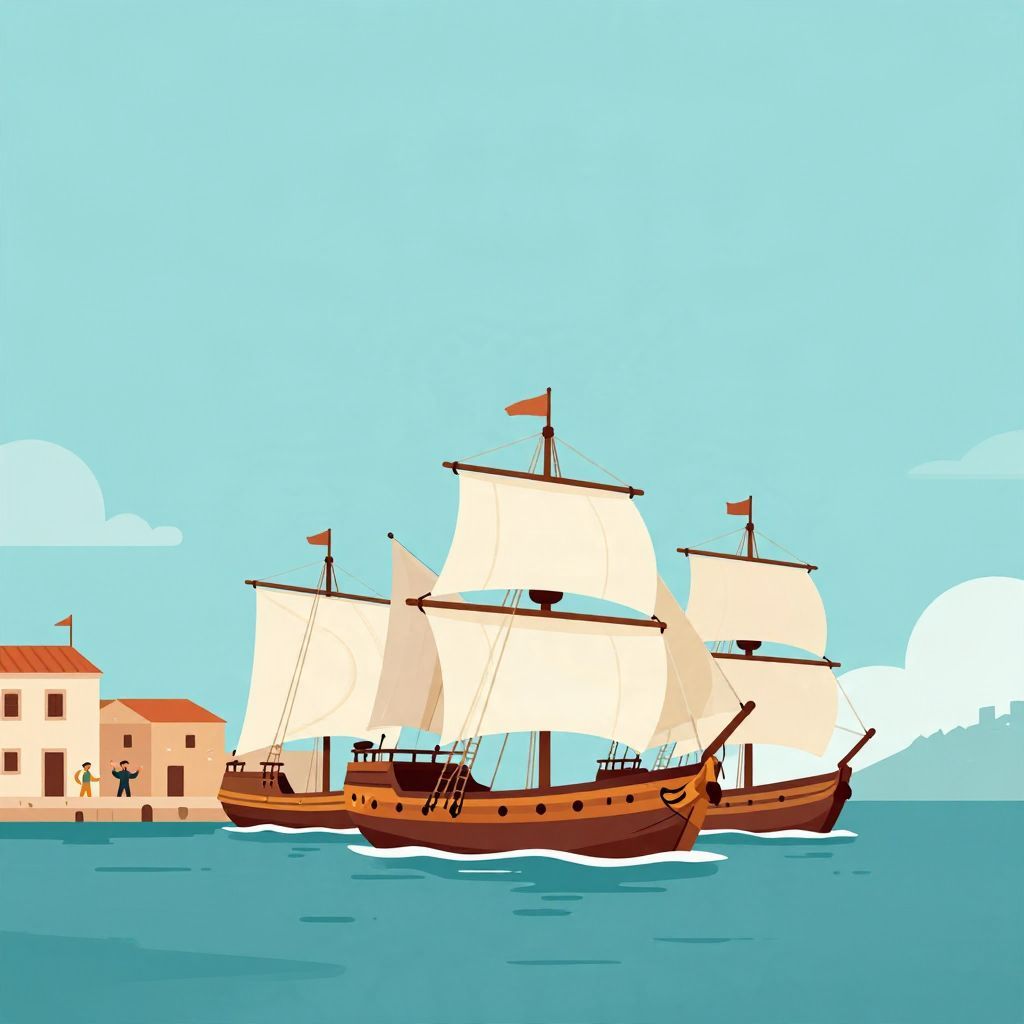
When did Columbus sail the ocean blue? The short answer is that Christopher Columbus set out from Spain on August 3, 1492, and his expedition reached the Caribbean on October 12, 1492. The famous rhyme points to that first voyage, which changed European knowledge of the Atlantic world, even though Columbus did not “discover” a new world in the absolute sense.
His journey is remembered because it marked the opening of sustained European contact with the Americas. But the story is more complicated than the popular line suggests: Columbus was searching for a westward route to Asia, not a new continent, and people already lived in the lands he reached.
When did Columbus sail the ocean blue?
Christopher Columbus sailed from Palos de la Frontera, Spain, on August 3, 1492. After stopping in the Canary Islands, he crossed the Atlantic and first landed in the Bahamas on October 12, 1492. That is the historical event behind the familiar phrase “Columbus sailed the ocean blue in 1492.”
The date behind the rhyme
The rhyme is a simplified memory aid, not a quotation from the 15th century. It refers to Columbus’s first voyage, which began in 1492 under the sponsorship of King Ferdinand and Queen Isabella of Spain. The date is well established in surviving records and in the chronology of the voyage.
In other words, if someone asks when Columbus sailed the ocean blue, the best direct answer is 1492—more precisely, August 3, 1492, for departure from Spain.
Why Columbus set sail in 1492
Columbus did not launch his voyage simply to “find America.” He wanted to reach Asia by sailing west across the Atlantic. In the late 15th century, European merchants and rulers were eager for access to Asian goods such as spices, silk, and precious metals. Columbus believed the Atlantic route would be shorter than sailing around Africa, though he underestimated the size of the Earth.
His proposal fit into a broader age of exploration. Portuguese navigators had already been pushing down the west coast of Africa, and Spain wanted its own share of overseas wealth and prestige. Columbus’s plan appealed to Spanish rulers because it offered a possible route to trade and expansion without competing directly on the established eastern routes.
Who supported the voyage?
Columbus gained backing from the Spanish crown after years of trying to secure support elsewhere. Ferdinand and Isabella agreed to finance the expedition, though the arrangement was cautious and conditional. Columbus was granted titles and privileges if he succeeded, reflecting both the risk and the ambition involved.
The expedition was not a lone heroic leap into the unknown. It was a state-sponsored venture shaped by politics, finance, navigation, and the growing competition among European powers.
What happened on the first voyage?
Columbus’s 1492 expedition consisted of three ships: the Niña, the Pinta, and the Santa María. After leaving Spain, the ships sailed to the Canary Islands for repairs and provisioning, then headed west into open ocean. The crossing took weeks and tested the crew’s endurance and confidence.
On October 12, 1492, the expedition reached land in the Bahamas. Columbus believed he had arrived near Asia, perhaps on islands off the coast of Japan or in the broader region Europeans called the Indies. That mistaken identity shaped the language Europeans used for decades afterward, including the term “Indians” for many Indigenous peoples of the Americas.
Where did he land?
Historians generally identify the first landing as an island in the Bahamas, often associated with Guanahani, though scholars have debated the exact modern location. What matters historically is that Columbus’s first landfall was in the Caribbean, not on the mainland of Asia.
He later visited parts of Cuba and Hispaniola during the same voyage. These encounters began a process of exploration, colonization, violence, exchange, and transformation that would reshape the Atlantic world.
Why the phrase “sail the ocean blue” became famous
The phrase is popular because it is short, rhythmic, and easy to remember. It is commonly used in school lessons about the year 1492. But the wording is modern and poetic rather than historical. Columbus himself did not describe his voyage in that exact phrase, and the line is best understood as a teaching device, not a primary-source statement.
That matters because the rhyme can make the event seem simple. In reality, the voyage was part of a much larger historical process involving empire, navigation, trade, and the encounter between different worlds.
A memory aid, not the full story
The rhyme captures only one part of the history: the departure in 1492. It leaves out the crew’s route, the stop in the Canaries, the mistaken belief that Asia had been reached, and the fact that the Americas were already inhabited. It also leaves out the long-term consequences for Indigenous peoples, who faced disease, conquest, forced labor, and displacement after European arrival.
What Columbus’s voyage changed
Columbus’s first voyage did not immediately prove that he had reached a separate continent. Even so, it opened a lasting connection between Europe and the Americas. Over time, European powers followed, and the Atlantic became a corridor of migration, conquest, trade, and cultural exchange.
The consequences were enormous. New crops, animals, diseases, and people moved across oceans in what historians often call the Columbian Exchange. This exchange transformed diets, economies, populations, and environments on both sides of the Atlantic.
Important consequences of 1492
- European colonization expanded in the Caribbean and later on the American mainland.
- Indigenous societies experienced devastating population loss from disease, war, and forced labor.
- Atlantic trade grew rapidly, eventually including the transatlantic slave trade.
- European geography changed as people gradually recognized that the lands reached were not Asia.
Did Columbus really “discover” America?
That phrase is misleading. Columbus was the first European to make a sustained, documented crossing that led to lasting European contact with the Americas, but he did not discover a land that was empty or unknown to all humans. Indigenous peoples had lived in the Americas for thousands of years, and other voyagers, including Norse travelers centuries earlier, had reached parts of North America.
So while 1492 is a major turning point in European history, it should not be treated as the beginning of human history in the Americas. The language of “discovery” reflects older European-centered storytelling and is now widely questioned by historians.
Why historians use more careful language
Modern historians often prefer phrases such as “Columbus’s first voyage,” “European arrival,” or “the beginning of sustained transatlantic contact.” These terms are more accurate because they avoid erasing Indigenous history and acknowledge that the event had different meanings for different peoples.
The timeline of Columbus’s first voyage
A simple chronology helps show how the expedition unfolded:
- August 3, 1492 — Columbus departs from Spain.
- August 1492 — The ships stop in the Canary Islands.
- September 1492 — The fleet crosses the Atlantic.
- October 12, 1492 — First landfall in the Bahamas.
- Late 1492 — Columbus explores parts of the Caribbean.
- March 1493 — He returns to Spain.
This sequence shows why the year 1492 is so central. The voyage began then, and its results quickly became part of European political and commercial history.
Why 1492 matters in world history
1492 is one of the most famous dates in history because it marks a turning point in global connections. Columbus’s voyage helped launch an era in which Europe became more directly tied to the Americas, Africa, and Asia through oceanic travel. That did not happen overnight, but the first voyage was a catalyst.
For Spain, the journey helped justify imperial expansion. For Europe, it widened geographic horizons. For Indigenous peoples of the Americas, it began a period of profound upheaval. The same event can therefore be remembered as exploration, conquest, tragedy, or transformation depending on the historical perspective.
So, when did Columbus sail the ocean blue?
Christopher Columbus sailed from Spain on August 3, 1492. His first voyage reached the Caribbean on October 12, 1492, which is the date most closely associated with the famous rhyme. The phrase is a modern shorthand for a far more complex historical event that changed the Atlantic world forever.
If you want to explore the topic further, you may also find these related articles useful: When Did Christopher Columbus Sail the Ocean Blue? and What Year Did Columbus Sail the Ocean Blue?