
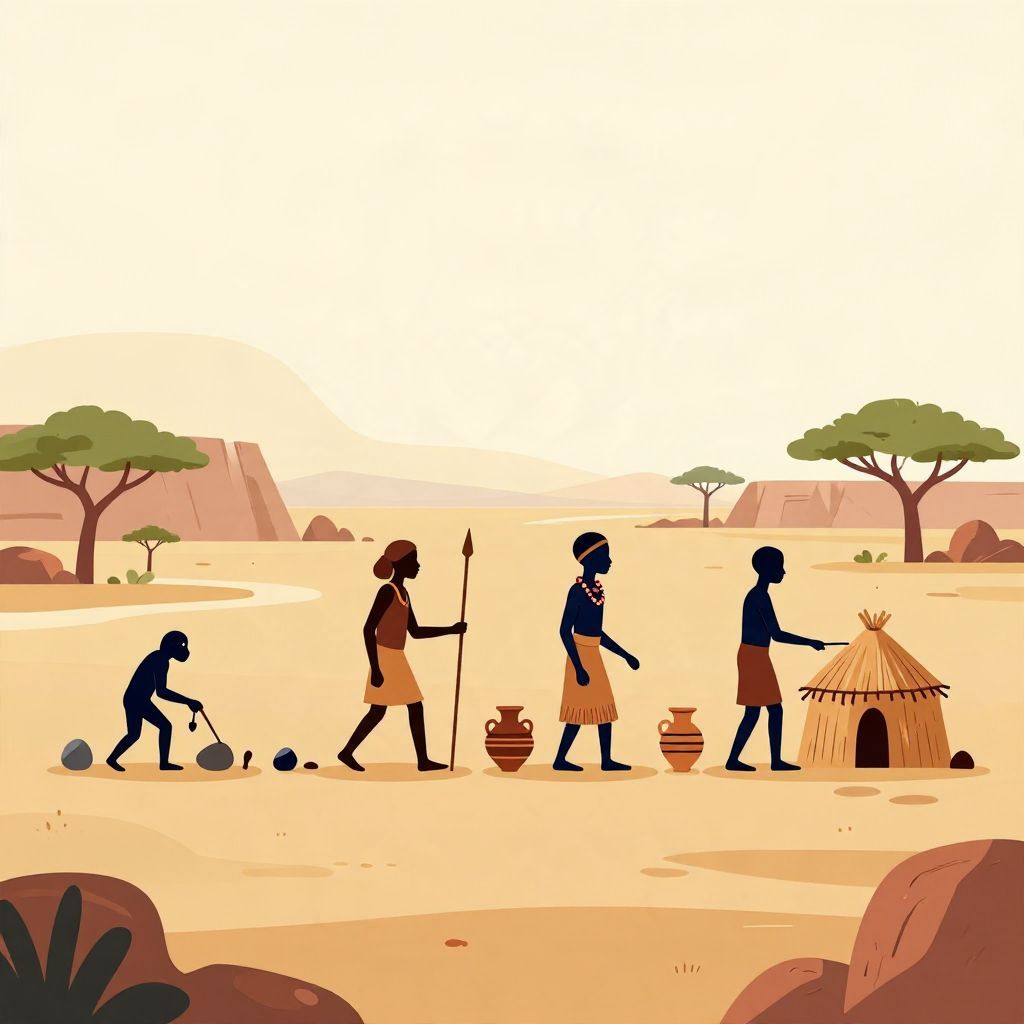
How old are African people? The short answer is that African people are not “old” in the sense of being a single age group or a single origin story. Africa is the continent where Homo sapiens first evolved, so the deepest roots of African peoples go back hundreds of thousands of years.
At the same time, the peoples of Africa are diverse, with many languages, cultures, and histories that developed over long periods. To answer the question well, we need to separate human origins, the age of African civilizations, and the later formation of modern African nations and identities.
How old are African people?
African people are part of the oldest continuous human story on Earth. Anatomically modern humans emerged in Africa about 300,000 years ago, based on fossil and archaeological evidence. But “African people” as a modern identity is much younger, because ethnic groups, kingdoms, and nations formed gradually over time.
What does “African people” mean historically?
The phrase can mean different things depending on the context. It may refer to all people living in Africa today, the ancestors of modern Africans, or the first human populations that evolved on the continent. Historians and anthropologists usually avoid treating Africa as one single people, because the continent has always contained many distinct communities.
Africa as the birthplace of humanity
The strongest scientific answer is that the human species originated in Africa. Fossils from sites in East and North Africa show early Homo sapiens appearing roughly 300,000 years ago, though the exact timing is still refined by new discoveries. This means the ancestors of all living humans, including Africans and non-Africans, ultimately trace back to ancient African populations.
Why the question is not simple
Modern identities such as Yoruba, Zulu, Amhara, Somali, Hausa, Berber/Amazigh, Kikuyu, and many others did not exist in the distant prehistoric past in their current forms. They developed through migration, language change, state formation, trade, religion, and local adaptation. So the “age” of African people depends on whether you mean the human species, a cultural group, or a nation.
The deep timeline of African people
African history stretches across an enormous span of time. The following timeline shows the broad sequence from early humans to modern states.
- c. 300,000 years ago: Early Homo sapiens appear in Africa.
- c. 70,000–50,000 years ago: Some human groups begin major migrations out of Africa.
- c. 10,000–3,000 BCE: Farming, herding, and settled communities expand in many regions.
- c. 3,000 BCE onward: States and kingdoms emerge in places such as Egypt and Nubia.
- 1st millennium CE: Large trade networks connect North, West, East, and Central Africa to the Mediterranean, Red Sea, and Indian Ocean.
- 15th–19th centuries: Atlantic slave trading, Indian Ocean trade, and expanding empires reshape many African societies.
- 19th–20th centuries: European colonial rule spreads across much of the continent.
- Mid-20th century onward: Most African countries gain independence and build modern national identities.
How old is Africa’s human history?
Human history in Africa is far older than written records. For most of this time, people left evidence through tools, bones, rock art, burial sites, and settlement patterns rather than documents. That is why archaeologists play such an important role in reconstructing African history.
Early humans and prehistoric Africa
Long before kingdoms or written languages, African communities adapted to changing climates, hunted animals, gathered plants, and later developed agriculture and pastoralism. These changes were not uniform across the continent. Some regions became farming centers early, while others remained based on hunting, fishing, or herding for much longer.
The rise of agriculture and settled life
Between about 10,000 and 3,000 BCE, climate shifts and domestication transformed many African societies. In the Nile Valley, the Sahara, the Sahel, the Ethiopian highlands, and parts of West and East Africa, people increasingly relied on farming and herding. This supported denser populations, larger settlements, and eventually states.
Ancient African civilizations and kingdoms
When people ask how old African people are, they often also mean how old African civilizations are. Some of the world’s earliest states developed in Africa, especially in the Nile Valley. These societies left monuments, writing systems, royal traditions, and administrative records that help historians date them more precisely.
Ancient Egypt
Ancient Egypt formed around the late fourth millennium BCE, with unification traditionally placed around c. 3100 BCE. Egyptian civilization lasted for millennia, changing over time through dynasties, foreign rule, and cultural exchange. It was one of the most influential early civilizations in world history.
Nubia and Kush
South of Egypt, Nubian societies developed along the Nile in what is now Sudan. The Kingdom of Kush became especially powerful from roughly the second millennium BCE onward. At times, Kushite rulers governed Egypt itself, showing that African political power was not limited to one region.
Other early African states
Across the continent, many other states emerged at different times. In West Africa, kingdoms such as Ghana, Mali, and Songhai became major centers of trade and learning. In East Africa, city-states along the Swahili Coast connected Africa to Arabia, Persia, India, and beyond. In southern Africa, states such as Great Zimbabwe later became important regional powers.
How old are modern African ethnic groups?
Modern African ethnic groups are much younger than the human species itself. Most formed over centuries or even millennia through interaction, migration, and political change. Some groups have deep historical roots, but their present-day identities are not frozen relics from prehistoric times.
Ethnicity changes over time
Ethnic identity is historical, not fixed. A group may begin as a cluster of related communities, then expand, split, merge, or change language and customs. For example, large language families such as Bantu, Afroasiatic, and Nilo-Saharan reflect long histories of movement and contact rather than single momentary origins.
Language and identity
Language often helps historians trace the age of a people, but it does not tell the whole story. Two communities may speak related languages and still have distinct traditions. Likewise, a single ethnic label can cover many local histories. That is why scholars study oral tradition, archaeology, linguistics, and written sources together.
How old are African nations?
Most modern African nations are quite recent compared with the continent’s ancient past. The borders of many African states were drawn during the colonial era, especially in the late 19th and early 20th centuries. Most independent African countries emerged after World War II, especially in the 1950s and 1960s.
Colonial borders and independence
European colonial powers divided much of Africa with little regard for existing political and cultural boundaries. After independence, new governments inherited these borders and worked to create national identities from highly diverse populations. This is one reason “African people” today often refers to citizens of modern states as well as older ethnic and regional identities.
Examples of modern state formation
- Ghana became independent in 1957, one of the first sub-Saharan African countries to do so.
- Nigeria gained independence in 1960.
- Kenya became independent in 1963.
- South Africa ended apartheid rule in 1994 with the first multiracial democratic election.
How historians determine age and chronology
Because the question spans such a long period, historians use several methods to estimate age. No single method answers everything, and each has limits. The best conclusions come from combining evidence.
Archaeology
Archaeologists study tools, bones, pottery, buildings, and settlement layers. Techniques such as radiocarbon dating and stratigraphy help establish approximate dates for human activity. This is essential for prehistoric Africa, where written records do not exist.
Written records
Where writing exists, historians can date rulers, wars, trade, and religious change more precisely. Ancient Egypt, later Islamic African states, and many coastal societies provide documentary evidence that complements archaeology.
Oral tradition
Oral history is also important in Africa. Griots, elders, royal traditions, and community memory preserve information that may not appear in written sources. Oral tradition must be handled carefully, since it can change over time, but it remains a valuable historical source.
Why the question matters
Asking how old African people are is really asking how deep African history goes. The answer challenges older stereotypes that treated Africa as having little history before colonial rule. In reality, Africa is central to human origins and to the development of agriculture, states, trade networks, religions, and cultures across the world.
Common misunderstandings
One common mistake is to imagine African peoples as a single group with one origin and one timeline. Another is to think African history begins with European contact. Both ideas are false. Africa’s past is older, broader, and more varied than those simplified stories suggest.
So, how old are African people in the end?
If you mean the ancestors of modern humans, African people are as old as Homo sapiens itself: about 300,000 years. If you mean modern ethnic groups, many are thousands of years old, though their identities have changed over time. If you mean modern African nations, most are less than a century old. Africa’s history is not one age, but many overlapping ages.
For readers who want to place this question in a broader timeline, it can help to explore related topics such as when hydrogen was discovered or what the Dark Ages were, both of which show how historians think about chronology and change over time. The deepest takeaway is simple: African history is among the oldest human histories on Earth, and it continues into the present.