
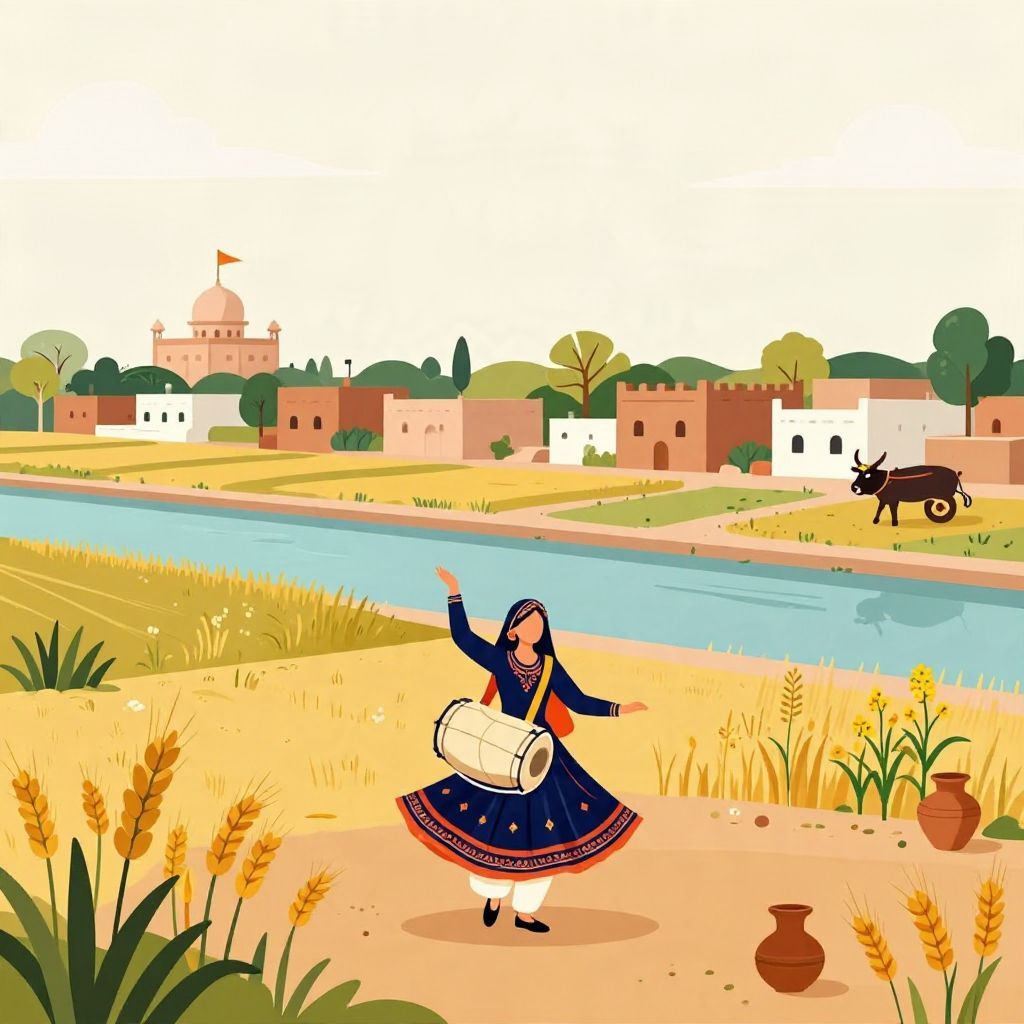
What is Punjabi? The word can mean a language, a person from the Punjab region, or the wider cultural identity associated with that area. Because the term is used in several ways, its meaning depends on context: linguistic, geographic, ethnic, and historical.
To understand Punjabi properly, it helps to look at the long history of the Punjab region, the evolution of its language, and the ways people have used “Punjabi” to describe identity across empires, migrations, and modern national borders.
What Is Punjabi?
Punjabi most commonly refers to the Punjabi language and to the people of Punjab, a historic region in South Asia now divided between India and Pakistan. It can also describe the region’s culture, literature, music, and traditions. In historical terms, Punjabi is not one single thing but a layered identity shaped by geography, language, religion, and political change.
The Historical Meaning of Punjab
The word Punjab comes from Persian and means “five waters” or “five rivers,” referring to the region between the five major rivers of the Indus system: the Jhelum, Chenab, Ravi, Beas, and Sutlej. This fertile river plain supported farming communities for thousands of years and became a crossroads of trade, conquest, and migration.
A region shaped by movement
Because Punjab sat between Central Asia, the Iranian plateau, and the Gangetic plains, it was repeatedly influenced by outside powers. Ancient, medieval, and early modern rulers came and went, but local languages, rural society, and regional customs remained resilient. That long continuity helps explain why “Punjabi” became a durable cultural label even as political borders changed.
Where Did the Punjabi Language Come From?
Punjabi is an Indo-Aryan language, part of the larger family that includes Hindi, Urdu, Bengali, and many other South Asian languages. It developed over centuries from older regional speech forms rather than appearing suddenly at one date. Scholars generally trace its growth through the medieval period, with clearer literary evidence emerging later.
From early vernaculars to a distinct language
Like many South Asian languages, Punjabi evolved from a mix of local dialects and the broader linguistic changes that followed the decline of Sanskrit as the main literary language. By the medieval era, spoken Punjabi had become distinct enough to support devotional poetry, oral storytelling, and regional expression. Its written forms later developed in different scripts, especially Gurmukhi and Shahmukhi.
Two major scripts
- Gurmukhi is used mainly in Indian Punjab and is strongly associated with Sikh religious and literary traditions.
- Shahmukhi, written in a Perso-Arabic script, is used mainly in Pakistani Punjab.
The existence of two major scripts reflects the region’s religious and political history. Script choice often signals education, community, and identity as much as language itself.
How Punjabi Identity Developed Historically
Punjabi identity grew from a combination of shared geography, language, and social life rather than from a single ancient nation-state. For much of history, people in Punjab identified locally, by religion, caste, clan, village, occupation, or ruler, while “Punjabi” functioned as a regional description. Over time, especially in the modern era, it became a stronger cultural and political identity.
Medieval and early modern Punjab
During the medieval period, Punjab came under a succession of powers, including the Delhi Sultanate and later the Mughal Empire. These regimes brought new administrative systems, Persianate court culture, Islamic scholarship, and migration. At the same time, the region produced important devotional movements, including Sikhism in the 15th and 16th centuries, which deeply shaped Punjabi religious and literary life.
The rise of Sikh tradition and Punjabi culture
Sikhism began with Guru Nanak in the late 15th century in the Punjab region. The Sikh Gurus used Punjabi and related vernaculars to communicate religious ideas to ordinary people. This helped elevate the language as a medium of spiritual and literary expression. Later, the compilation of Sikh scripture and the growth of Sikh institutions strengthened the status of Punjabi, especially in written and devotional form.
Punjabi Under Empire, Colonial Rule, and Partition
Punjab’s history changed dramatically under colonial rule. The British annexed the Sikh Empire’s Punjab in 1849, bringing the region into British India. Colonial administrators classified people by religion, caste, and language, which influenced how Punjabi identity was recorded and understood. Railways, canals, schools, and new administrative boundaries also altered daily life and migration patterns.
Partition in 1947
The most important modern turning point was the Partition of India in 1947. Punjab was divided between the new states of India and Pakistan, and the partition triggered one of the largest and most violent population exchanges in modern history. Millions of Hindus, Sikhs, and Muslims were displaced. This event reshaped Punjabi identity by splitting families, communities, shrines, and literary networks across a new international border.
After Partition, Punjabi continued to be spoken on both sides, but state policies differed. In India, Punjabi became associated especially with Sikh-majority eastern Punjab, while in Pakistan it remained the language of a large population but often had less official prestige than Urdu. These political choices affected education, publishing, and public recognition of the language.
What Are the Main Features of Punjabi Culture?
Punjabi culture is broad and diverse, but it is often associated with strong oral traditions, music, hospitality, agricultural life, and a rich religious landscape. It is not limited to one religion or one country. Muslims, Sikhs, Hindus, and others have all contributed to Punjabi history and culture.
Music, dance, and oral tradition
Punjabi music is known for its energy and community spirit. Folk forms such as bhangra and giddha developed in rural settings and were connected to harvest celebrations, weddings, and seasonal festivals. Oral storytelling, proverbs, and ballads also played a major role in preserving memory and values before mass literacy became widespread.
Food, agrarian life, and social customs
Punjab’s fertile land made agriculture central to its economy and culture. Farming shaped diet, labor, and social relations. Many foods now widely associated with Punjabi cuisine—such as wheat breads, dairy-based dishes, lentils, and spiced vegetables—reflect the region’s agricultural abundance. Hospitality and communal eating are also important cultural themes, though practices vary by family, locality, and religion.
Religion and diversity
Punjab has long been religiously diverse. Islam, Sikhism, Hinduism, and earlier traditions all left their mark on the region. Shrines, pilgrimage sites, and shared local customs often crossed religious boundaries. At the same time, religious identities sometimes became politically charged, especially in the 19th and 20th centuries. Punjabi culture therefore cannot be reduced to a single faith or community.
Punjabi in Literature and Education
Punjabi literature includes devotional poetry, folk verse, modern fiction, and political writing. Some of the most influential early works were tied to religion and oral performance, while modern Punjabi literature expanded in the 19th and 20th centuries with printing, newspapers, and schools. Writers used Punjabi to explore love, loss, migration, partition, rural change, and identity.
Literary significance
The language’s literary history matters because it shows that Punjabi was never merely a spoken dialect. It has a long record of written expression in different scripts and communities. Modern standardization efforts, however, have sometimes created tension between regional speech, literary norms, and state language policy.
Punjabi as an Identity in the Modern World
Today, “Punjabi” can mean several overlapping things: a speaker of the language, a resident or descendant of the Punjab region, or someone who identifies with Punjabi cultural traditions. Large Punjabi-speaking communities also live outside South Asia, especially in the United Kingdom, Canada, the United States, and the Gulf states, where migration has carried the language into new settings.
Language and diaspora
In the diaspora, Punjabi often becomes a marker of family heritage and community belonging. Some second- and third-generation migrants maintain the language at home, in religious institutions, or through music and media, while others know it mainly as a cultural symbol. This shows how identity can survive even when everyday language use changes.
Common Misunderstandings About Punjabi
One common mistake is to treat Punjabi as if it referred only to Sikhs. In fact, Punjabi identity includes Muslims, Hindus, Sikhs, Christians, and others. Another misunderstanding is to assume Punjabi is only a modern ethnic label. In reality, it has older regional roots and developed gradually through history.
It is also important not to confuse language with nationality. A person may be Punjabi by language or culture while being Indian, Pakistani, British, Canadian, or another nationality. Historical identity in Punjab has often been layered rather than singular.
Why Punjabi Matters Historically
Punjabi matters because it reveals how language, region, and history interact. The term captures a long-lived cultural world shaped by rivers, agriculture, empire, religion, migration, and partition. It also shows how identities can be both ancient in their roots and modern in their political form.
In short, Punjabi is the name of a language, a people, and a regional culture whose history stretches from the early development of North Indian vernaculars to the upheavals of colonial rule and Partition. For related context, see what cultural divergence means in history and how nationalism shaped modern history.