
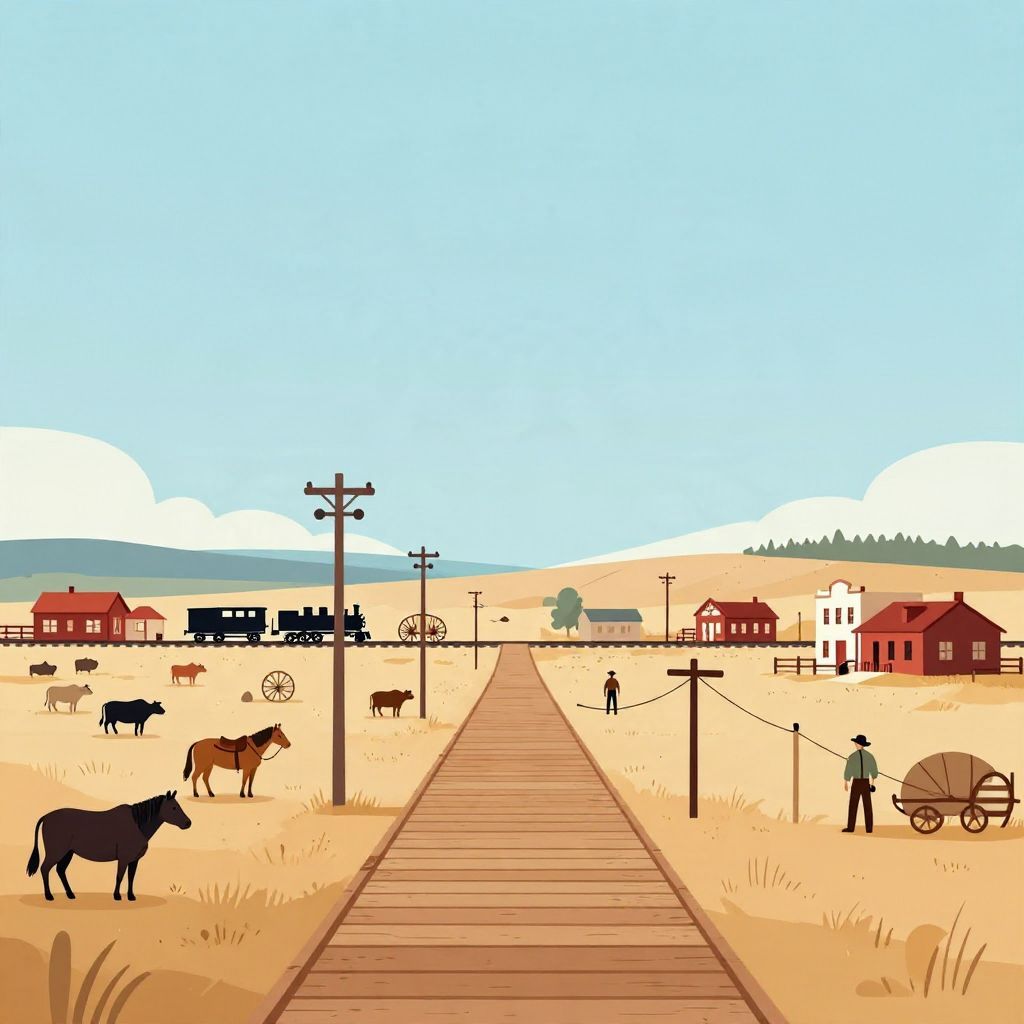
When did the Wild West end? The short answer is that there is no single exact date. Historians usually place the end of the “Wild West” era in the late 1890s to early 1900s, when railroads, state governments, federal law enforcement, fenced ranching, and urban growth had largely replaced the frontier conditions that made the West seem “wild.”
That said, the phrase “Wild West” is partly a historical reality and partly a later myth. Its end depends on whether you mean the closing of the frontier, the decline of gunfights and outlaw towns, or the fading of a romantic frontier culture in popular memory.
When did the Wild West end?
Most historians say the Wild West ended gradually between the 1880s and 1910s, with the symbolic end often linked to 1890, when the U.S. Census declared the frontier line no longer clearly existed. In practical terms, many frontier-style conditions persisted in some places for years, but the era of open, unsettled expansion was largely over by then.
The most famous date: 1890
The year 1890 matters because the U.S. Census Bureau announced that there was no longer a continuous frontier line separating settled from unsettled land. This did not mean every part of the West was fully developed, but it did mean that the broad frontier zone—where settlement was sparse and institutions were still forming—had largely disappeared.
That census statement became a powerful historical marker because it captured a bigger change already underway: railroads connected towns, telegraphs sped communication, territorial governments became states, and federal authority reached much farther into the West.
Why the answer is not a single year
The “Wild West” was never one uniform place or one fixed moment. In some regions, especially in the Southwest and parts of the Great Plains, frontier-like conditions lasted longer than in others. Violence, cattle drives, and lawlessness did not vanish overnight. Instead, the West changed unevenly as population increased and institutions strengthened.
What people mean by the “Wild West”
The phrase “Wild West” usually refers to the American frontier period of the 19th century, especially the decades after the Civil War, when settlers moved westward into lands that were often sparsely governed by U.S. institutions. It evokes cowboys, outlaws, mining camps, Native American resistance, gunfights, and boomtowns.
Historically, the term is broader and more complicated than the movie version. The West included farming communities, Native nations, military forts, rail hubs, mining towns, and growing cities. It was not simply a lawless vacuum; it was a contested region shaped by migration, conquest, commerce, and state-building.
Frontier life versus the popular myth
Popular culture often imagines the Wild West as a brief era of constant shootouts and unbroken lawlessness. In reality, many western towns had courts, sheriffs, churches, schools, and newspapers. Violence was real, but it was not the only defining feature. The “wild” reputation grew partly from sensational journalism, dime novels, and later Hollywood films.
What actually ended the Wild West?
The end of the Wild West came through several overlapping changes: the closure of the frontier, the expansion of transportation and communication, the growth of state and federal power, and the transformation of the economy from open-range and extraction to settled agriculture, ranching, and urban development.
1. Railroads and telegraphs
Railroads were one of the biggest forces ending frontier isolation. They brought settlers, goods, and law enforcement faster than wagon travel ever could. Rail lines also made it easier to ship cattle, minerals, and crops, tying western communities to national markets. The telegraph made it harder for outlaws to disappear and easier for authorities to coordinate responses.
2. Statehood and stronger government
As territories became states, they gained more stable legal systems, elected officials, courts, and police structures. Federal troops and marshals also played a larger role in enforcing order, especially in conflicts involving land claims, Native resistance, and major crimes. This did not eliminate violence, but it reduced the conditions that had allowed some frontier towns to function with very weak oversight.
3. The decline of open-range cattle culture
One of the classic symbols of the Wild West was the open-range cattle drive. By the late 19th century, barbed wire fencing, railroad shipping, and privatized land use made long drives less necessary. The open range did not disappear instantly, but the economic world of the cowboy changed dramatically. Ranching became more controlled and less dependent on the vast, unfenced spaces of earlier decades.
4. Native dispossession and military campaigns
The expansion of U.S. settlement depended heavily on the dispossession of Native peoples. As Native nations were forced onto reservations through warfare, treaties, and broken agreements, the frontier itself was transformed. This is a central part of the story, because the “end” of the Wild West for settlers often meant the suppression of Indigenous sovereignty and the consolidation of U.S. control.
Key milestones in the closing of the frontier
If you want a timeline rather than a single date, these milestones help explain how the Wild West ended in stages:
- 1860s–1870s: Post-Civil War expansion accelerates; cattle trails, mining camps, and railroad building reshape the West.
- 1880s: More towns become connected to railroads, barbed wire spreads, and territorial governments strengthen.
- 1890: The U.S. Census declares the frontier line effectively gone.
- 1890s: Major frontier conflicts decline, though some violence and resistance continue.
- Early 1900s: The West becomes more fully integrated into national economic and political life.
1890 as a symbol, not a finish line
The census year is the most famous marker because it is easy to remember, but it should be understood as symbolic. Some places still felt frontier-like after 1890, and some communities remained isolated for decades. Even so, by then the major era of rapid westward expansion had ended, and the West was entering a more modern phase.
Did famous gunfighters and outlaws mark the end?
Not exactly, though the decline of famous outlaw culture is part of the story. The deaths, arrests, or retirements of well-known figures did not by themselves end the Wild West, but they reflected a larger shift. As law enforcement became more effective, the opportunities for roaming outlaws narrowed.
The fading of the outlaw era
By the late 19th century, many notorious outlaw gangs had been broken up, tracked down, or pushed out of business. Improved communication, rail travel, and organized posses made it harder for criminals to outrun the law. The romantic outlaw image survived in stories, but the social conditions that had allowed such figures to flourish were disappearing.
Gunfights did not define the whole West
Popular memory often treats gunfights as the essence of the Wild West. In truth, actual shootouts were relatively rare compared with everyday work, travel, farming, and trade. The decline of dramatic violence mattered, but the deeper change was the end of a frontier society in which institutions were still being built.
How the West changed after the frontier ended
After the frontier era, the American West did not stop evolving; it became more urban, industrial, and politically connected. Mining, agriculture, oil, irrigation projects, and tourism all expanded. Western cities grew quickly, and the region became more tightly integrated into the national economy.
From frontier to modern region
By the early 20th century, the West was no longer chiefly defined by settlement on the edge of expansion. Instead, it was becoming a region of railroads, farms, ranches, mines, and cities. The “wild” image survived in books, films, and festivals, but it increasingly belonged to memory rather than daily life.
The myth outlived the reality
The Wild West became a powerful American legend because it offered stories of freedom, danger, self-reliance, and conflict. Those stories often left out Native perspectives, the role of federal power, and the realities of labor and settlement. So while the historical frontier ended in the late 19th century, the myth of the Wild West continued to grow long afterward.
So, when did the Wild West end?
The best historical answer is that the Wild West ended gradually, not all at once. If you need one date, 1890 is the most common symbolic answer because the U.S. frontier was declared effectively closed. If you want the broader historical reality, the era faded from the 1880s into the early 1900s as settlement, railroads, statehood, and federal authority transformed the West.
In other words, the Wild West ended when the frontier stopped being a frontier. Its legacy, however, lived on in American memory, politics, and popular culture. For related context on the broader forces shaping U.S. expansion and change, see what American imperialism was and broader 20th-century social change in how Martin Luther King changed the world.