
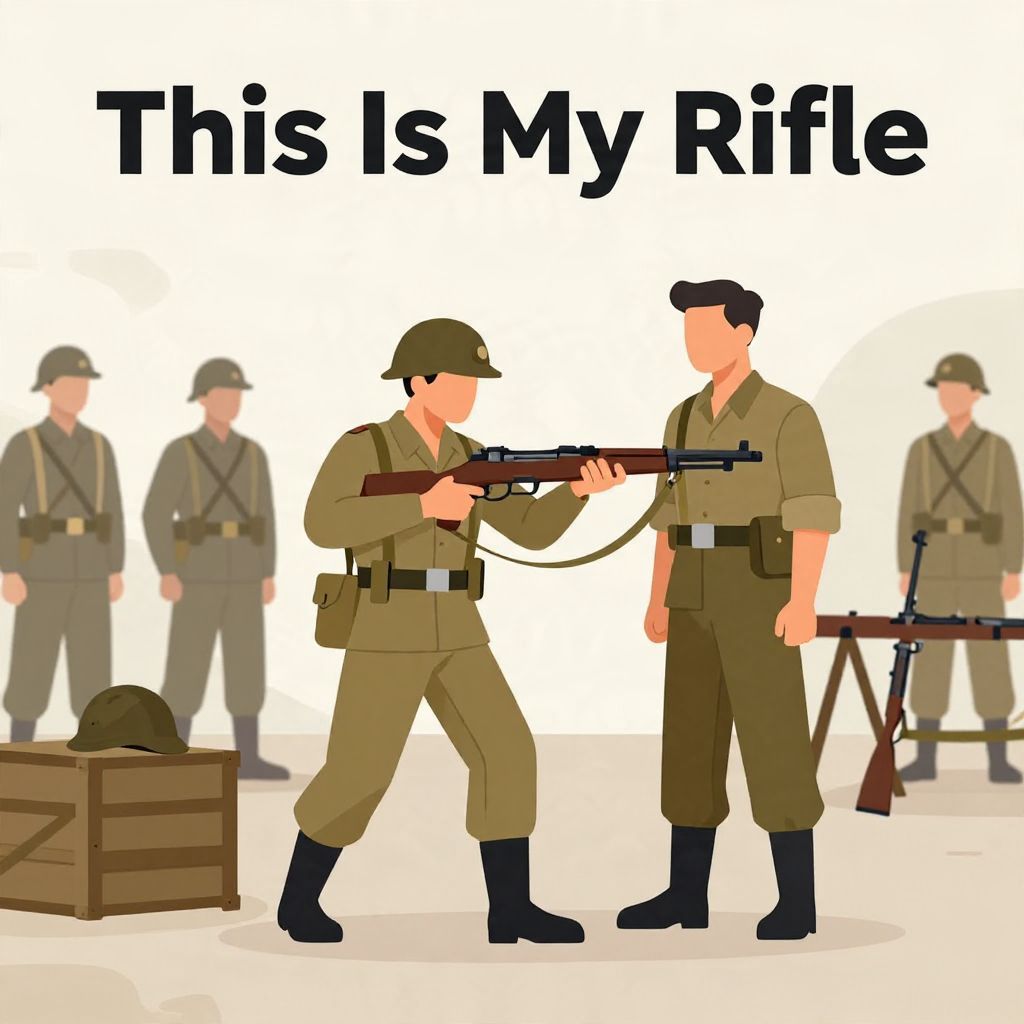
“This Is My Rifle” is best known today as a military-culture phrase from Full Metal Jacket, but its roots are older than the film. It points to the Marine Corps’ long emphasis on discipline, personal responsibility, and weapon familiarity, especially in training. The phrase became famous because the movie turned a drill into a memorable scene, but the ideas behind it reflect real military practice.
To understand it properly, we need to separate the historical Marine Corps tradition from the fictionalized version popularized by cinema. The phrase is not a famous battle cry from a single historic event; rather, it is part of a broader culture of drill, identity, and weapons training that has evolved over time.
What does “This Is My Rifle” actually mean?
“This Is My Rifle” refers to a Marine Corps drill chant associated with rifle handling, discipline, and personal accountability. In its most famous form, it appears in Stanley Kubrick’s 1987 film Full Metal Jacket, where recruits recite and repeat the phrase during training. Historically, it captures a real military principle: a soldier’s weapon is both a tool and a responsibility.
Where did the phrase come from?
The exact wording became widely recognized through Full Metal Jacket, but the underlying practice of assigning a rifle to a recruit and drilling that recruit to care for it is much older. Military training in the 20th century often used repetitive chants, inspections, and ritualized language to build obedience and cohesion. The phrase is therefore better understood as a cinematic crystallization of real boot-camp culture than as a single documented historical slogan with one origin point.
Boot camp, ritual, and discipline
Repetition in military training serves several purposes. It teaches muscle memory, reinforces hierarchy, and helps transform civilians into soldiers. In the Marine Corps especially, drill instructors have long used intense verbal instruction to create unity and stress-test recruits. A phrase like “This is my rifle” fits that environment because it links identity to equipment: the rifle is not just issued property, but something the recruit must know intimately.
The rifle as a symbol
In modern infantry warfare, the rifle is the soldier’s primary personal weapon. That makes it a powerful symbol of both survival and duty. Military organizations often encourage soldiers to treat weapons with care, precision, and respect. In that sense, “This Is My Rifle” reflects a broader military ethic rather than a uniquely Marine invention.
How Full Metal Jacket made it famous
The phrase became iconic because of Stanley Kubrick’s Vietnam War film Full Metal Jacket (1987). In the film’s training sequence, Marine recruits repeat the line in a call-and-response drill that is deliberately unsettling, darkly comic, and unforgettable. The scene helped turn a military training device into a widely recognized piece of popular culture.
Why the scene stood out
Kubrick’s film is structured around the dehumanizing pressures of military training and combat. The rifle chant is memorable because it is both absurd and serious: the recruits speak as if the weapon is part of their identity, while the scene also reveals how training can reshape language and behavior. That tension made the phrase stick in public memory.
Not a documentary, but not random either
Although the film is fictional, it draws on real Marine boot-camp practices and Vietnam-era military culture. The movie is not a literal historical record, and viewers should not treat every line as exact documentation. Still, it reflects genuine features of training: discipline, repetition, and the intense relationship between Marines and their rifles.
The historical background of rifle training in the U.S. military
To understand the phrase’s significance, it helps to look at the broader history of rifle training. As firearms became more central to infantry warfare in the 19th and 20th centuries, armies increasingly emphasized marksmanship, maintenance, and standardized drill. The individual soldier’s competence with a rifle became a major part of military effectiveness.
From massed fire to individual skill
Earlier armies often relied heavily on formation tactics, volleys, and close-order drill. By the late 19th and early 20th centuries, however, improved rifles, better training, and changing battlefield conditions made individual accuracy more important. A soldier needed to understand not only how to fire, but how to clean, carry, and maintain the weapon under difficult conditions.
Marine Corps culture and the rifleman ideal
The U.S. Marine Corps has long cultivated an image of the Marine as a rifleman first. This idea is central to Marine identity and training philosophy. Even as the Corps expanded into amphibious warfare, aviation, and combined-arms operations, the rifle remained a symbol of basic competence and combat readiness. The phrase “This Is My Rifle” fits neatly into that tradition.
Is “This Is My Rifle” a real Marine Corps saying?
It is real in the sense that it reflects authentic Marine training culture, but its exact fame comes from popular culture rather than from a single official historical slogan. The phrase is best known from Full Metal Jacket, and many people encounter it there first. That means its cultural history is stronger than its documentary history.
What can be said with confidence
- The phrase is strongly associated with Marine boot camp culture.
- Its most famous appearance is in Full Metal Jacket.
- It reflects real military ideas about discipline, ownership, and weapons handling.
- It is not best understood as the name of a famous battle, formal doctrine, or historic slogan from a single dated source.
What remains uncertain
It is difficult to trace one definitive first use of the exact wording in military history. Training phrases often circulate informally, and many are altered over time. Because of that, historians should be cautious about claiming a precise origin unless a documented source appears. The safer conclusion is that the phrase belongs to a long tradition of drill language and was popularized by film.
Why the phrase still matters
“This Is My Rifle” remains culturally significant because it captures how military institutions shape identity. The phrase is about more than a weapon. It suggests ownership, discipline, and the transformation of an individual into part of a fighting force. That is why it continues to be quoted, parodied, and recognized long after the Vietnam War era.
Military culture in popular memory
Popular culture often preserves military language in simplified form. A film line can become more familiar than the historical practices behind it. In this case, the phrase survives because it is short, dramatic, and tied to a powerful movie scene. Yet its endurance also reveals something real: modern armies rely on training rituals that are designed to shape behavior under pressure.
Beyond the movie
The phrase has also become part of broader internet and fan culture, where it is sometimes quoted with little awareness of its military context. That is common with famous film lines. Still, understanding the historical background makes the phrase more interesting, because it shows how cinema can transform a practical training idea into a lasting cultural symbol.
What the phrase tells us about war and training
At its core, “This Is My Rifle” tells a history of militaries in the modern era: soldiers are trained not only to fight, but to internalize discipline through repetition and ritual. The rifle becomes a stand-in for responsibility, identity, and readiness. The phrase’s power comes from that blend of practicality and symbolism.
Key historical takeaway
The phrase is not a famous historical quotation from a war leader or a battlefield event. Instead, it is a memorable expression of Marine training culture, made famous by Full Metal Jacket and rooted in the real history of military drill. Its lasting appeal lies in how it connects a simple object—a rifle—to the larger history of discipline, warfare, and identity.
If you are interested in the culture surrounding the Marine Corps and its public image, you may also want to read about why Marines are called “crayon eaters” and what “Full Metal Jacket” means.