
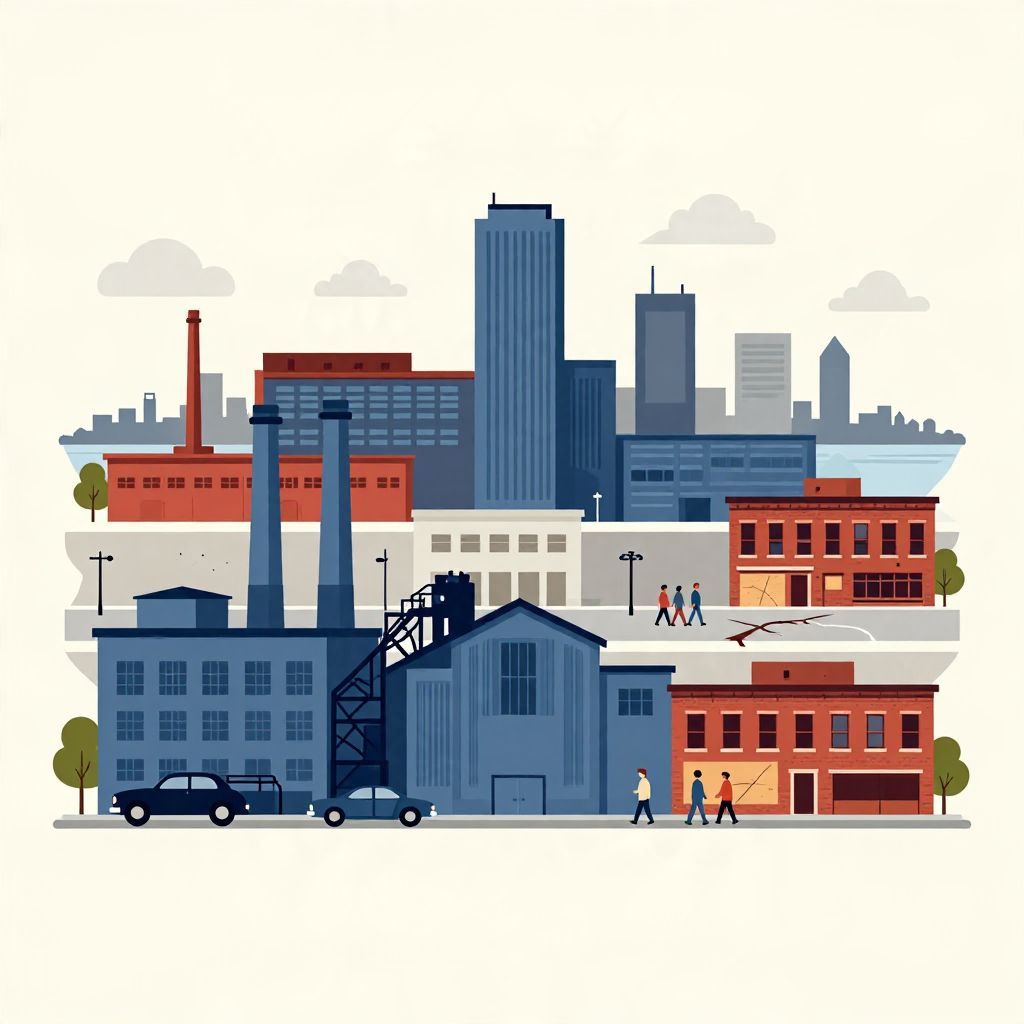
What happened to Detroit is a story of rise, reinvention, and painful decline followed by partial recovery. Once one of America’s fastest-growing industrial cities, Detroit became the center of the automobile age, then struggled with deindustrialization, suburbanization, population loss, and fiscal crisis. Its history is not a simple collapse, but a long chain of economic, political, and social changes.
Understanding Detroit means tracing how a manufacturing powerhouse became a symbol of urban crisis—and why the city is still rebuilding today. The answer lies in the city’s industrial boom, mid-20th-century racial and economic tensions, and the long aftermath of factory closures and shrinking tax revenue.
What Happened to Detroit?
Detroit rose as a global industrial capital in the early 20th century, then declined after World War II as auto jobs left the city, residents moved to the suburbs, and the tax base eroded. Decades of disinvestment, segregation, and political strain deepened the crisis. In 2013, Detroit filed for bankruptcy, the largest municipal bankruptcy in U.S. history.
Detroit’s Rise: From Frontier Town to Industrial Giant
The city’s early growth
Detroit was founded in 1701 as a French settlement on the Detroit River, a strategic location linking the Great Lakes. For much of the 18th and 19th centuries, it remained a modest regional center. Its transformation began in the late 1800s, when railroads, shipping, and manufacturing expanded rapidly.
The automobile boom
Detroit’s defining moment came in the early 20th century, when the automobile industry took root there. Companies associated with Henry Ford, General Motors, and Chrysler turned the city into the world’s automotive capital. Mass production created thousands of high-paying industrial jobs and drew migrants from the American South, Europe, and later from other parts of the United States.
By the 1920s and 1930s, Detroit had become a symbol of modern industrial power. Its population surged, neighborhoods expanded, and the city’s identity became closely tied to factory work and unionized labor. For many residents, Detroit represented opportunity and upward mobility.
Why Did Detroit Decline?
Deindustrialization and job loss
Detroit’s decline was driven first by the loss of manufacturing jobs. After World War II, automobile production increasingly spread to suburban plants, then to other states and countries where labor and land were cheaper. Automation reduced the number of workers needed in factories, while competition and changing business strategies weakened the city’s industrial base.
As jobs disappeared, many middle-class families followed them out of the city. The loss of employment did not happen overnight, but over decades it steadily reduced Detroit’s economic strength. The city’s fate was tied to an industry that no longer needed as many workers in one place.
Suburbanization and tax loss
Another major factor was suburbanization. Federal housing policy, highway construction, and postwar preferences for single-family homes encouraged many residents—especially white middle-class families—to leave the city for suburbs. Businesses also relocated, taking property tax revenue with them.
This mattered because cities depend heavily on a stable tax base to fund schools, police, transit, and infrastructure. As Detroit lost population and taxable property, it had fewer resources to maintain services. The city was still large, but it was being asked to support the needs of a much smaller and poorer population.
Racial segregation and unrest
Detroit’s decline cannot be understood without race. Housing discrimination, redlining, and unequal access to jobs and loans shaped where people could live and how wealth accumulated. Black Detroiters faced exclusion from many suburban opportunities even as they helped power the city’s industrial economy.
Tensions exploded in the 1967 Detroit uprising, one of the most significant urban rebellions in U.S. history. Triggered by a police raid and fueled by long-standing grievances over racism, poverty, and police brutality, the unrest left dozens dead and much of the city damaged. It did not cause Detroit’s decline by itself, but it accelerated white flight and deepened distrust between residents and government.
Key Events in Detroit’s Decline
Detroit’s troubles unfolded over many years rather than in a single collapse. A simplified timeline helps show how the crisis built up:
- 1940s–1950s: Postwar prosperity coexists with suburban growth and early industrial dispersal.
- 1967: The Detroit uprising intensifies fears, flight, and disinvestment.
- 1970s: Auto competition, oil shocks, and factory restructuring reduce employment.
- 1980s–1990s: Population loss continues; abandoned properties and shrinking revenues become more visible.
- 2000s: The housing crash and recession hit Detroit especially hard.
- 2013: Detroit files for bankruptcy.
- 2014 onward: The city exits bankruptcy and begins a slow recovery, uneven across neighborhoods.
The 1970s and 1980s
In the 1970s, Detroit faced a harsher economic environment. Foreign automakers gained market share, energy costs rose, and companies modernized production in ways that reduced labor demand. The city’s unemployment rate climbed, and many neighborhoods saw declining property values and increasing vacancy.
By the 1980s, Detroit had become a national example of urban distress. Yet even then, the city was not empty or abandoned. Large numbers of people still lived, worked, and organized there. The problem was not disappearance, but a shrinking city trying to function with far fewer resources than before.
The 2008 recession and bankruptcy
The financial crisis of 2008 made Detroit’s long-term problems far worse. Falling home values, reduced tax revenue, and rising service costs strained the city budget. In 2013, Detroit filed for bankruptcy protection, citing billions of dollars in debt and long-term obligations it could no longer meet.
The bankruptcy was historic, but it was also the culmination of decades of structural decline. It reflected not just mismanagement, though that played a role, but the accumulated effects of population loss, weakened industry, and fiscal imbalance. In 2014, Detroit exited bankruptcy after a court-approved restructuring plan.
What the Bankruptcy Meant
Services, debt, and public trust
Bankruptcy allowed the city to renegotiate debts and pensions, but it did not instantly solve Detroit’s underlying problems. Residents had endured years of reduced services, including poor street lighting, slow emergency response times, and deteriorating infrastructure. The crisis also raised difficult questions about who should bear the cost of the city’s financial collapse.
For many observers, Detroit became a case study in what happens when a city’s economic base disappears faster than its institutions can adapt. For residents, however, it was also a matter of daily life: whether neighborhoods were safe, whether schools worked, and whether basic services could be restored.
Did Detroit Recover?
A city of uneven renewal
Detroit has not returned to its mid-20th-century peak, and it likely never will in the same form. But the city has not remained frozen in decline either. Downtown and some core districts have seen new investment, renovated buildings, entertainment development, and efforts to attract residents and businesses.
At the same time, many neighborhoods still face poverty, vacant land, and uneven access to opportunity. Detroit’s recovery has been real but uneven, with visible progress in some areas and persistent hardship in others. That contrast is central to the city’s modern story.
Population and identity
Detroit’s population fell dramatically from its peak in the mid-20th century, but the city remains one of the most important urban centers in the Midwest. Its identity has also changed. Once defined almost entirely by the auto industry, Detroit is now associated with redevelopment, music history, Black culture, architecture, and resilience.
The city’s cultural legacy is especially important. Detroit shaped Motown, labor politics, Black political life, and American industrial design. Even in decline, it remained influential far beyond Michigan.
The Bigger Historical Meaning of Detroit’s Story
Detroit’s history shows how deeply cities depend on the industries, policies, and social patterns around them. Its rise came from mass production, migration, and industrial concentration. Its decline came from automation, suburbanization, racial inequality, and the loss of a tax base that once seemed permanent.
That does not mean Detroit’s fate was inevitable. Different policy choices might have softened the decline, and some scholars emphasize the role of local governance, regional fragmentation, and federal housing policy. Others stress global economic change and the limits of a city built around one dominant industry. In reality, all of these forces mattered.
Conclusion
What happened to Detroit was not a single disaster but a long transformation: industrial boom, postwar flight, racial conflict, economic restructuring, and eventual bankruptcy, followed by a difficult recovery. Detroit remains a powerful example of how a great industrial city can be reshaped by forces larger than any one mayor, company, or decade. For related historical stories, see what happened to the Montreal Expos and what happened in 1991.