
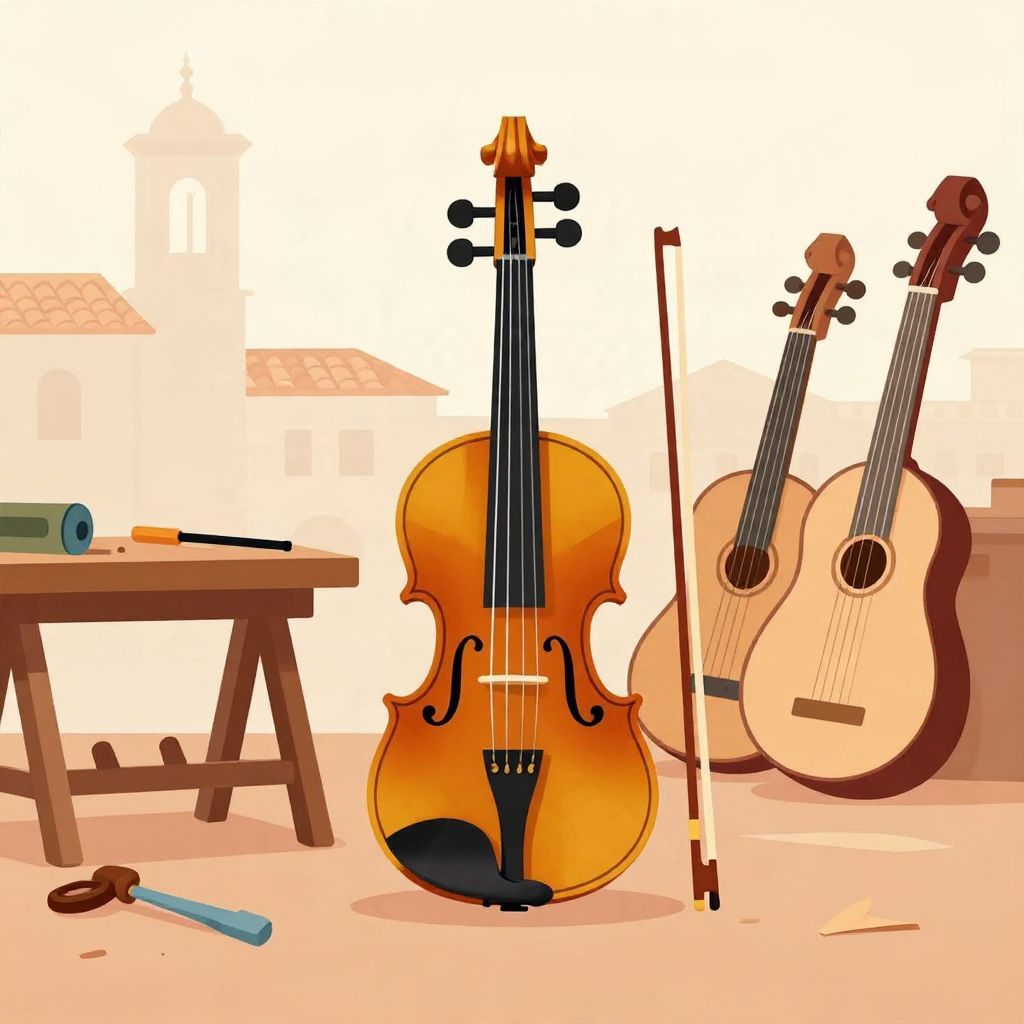
When was the violin invented? The short answer is that the violin emerged in northern Italy in the early 1500s, with the modern form taking shape by about the 1550s. It was not invented all at once by a single person, but developed from earlier bowed instruments.
Its story is tied to Renaissance music, craft traditions in cities such as Brescia and Cremona, and the gradual standardization of shape, size, and sound that made the violin the instrument we recognize today.
When Was The Violin Invented?
The violin was invented in early 16th-century Italy, most likely between about 1520 and 1550. Scholars generally agree that it appeared as a distinct instrument in the Renaissance rather than in antiquity, and that it evolved from earlier bowed string instruments rather than being created from nothing.
Because the violin developed gradually, there is no single “birthday” for it. The earliest clear references and surviving instruments point to northern Italy, especially the regions around Brescia and Cremona, where makers refined the instrument’s shape and sound into the familiar violin family.
The Violin’s Origins in Renaissance Italy
From bowed instruments to the violin
The violin did not appear in isolation. It grew out of a broader family of medieval and Renaissance bowed string instruments, including the lira da braccio, the rebec, and the viola da gamba family. These instruments showed that European musicians were already experimenting with bows, resonating bodies, and different tuning systems long before the violin became standard.
What made the violin new was not simply the use of a bow, but a combination of features: a smaller body, four strings, tuned in fifths, and a design that produced a brighter, more projecting tone. Those traits helped it stand out in dance music, court music, and eventually concert music.
Why northern Italy?
Northern Italy in the 1500s was a center of craftsmanship, trade, and musical innovation. City workshops produced lutes, viols, and other stringed instruments for courts and churches. Skilled makers were able to refine wood selection, varnish, arching, and string setup in ways that improved both volume and clarity.
Italian courts also demanded flexible instruments that could accompany dances, outdoor events, and ensemble music. The violin’s sound was well suited to these settings, which helped it spread quickly once musicians recognized its advantages.
The Earliest Evidence for the Violin
Written references
One of the challenges in answering when the violin was invented is that early instruments often survive better in records than in physical form. Written sources from the first half of the 1500s mention violins or similar terms, showing that the instrument was already known by then. These references are important because they place the violin firmly in the Renaissance, even if they do not identify one exact inventor.
By the mid-16th century, the violin was clearly established enough to appear in inventories, music collections, and descriptions of performances. That means the instrument was not a late invention of the 1600s, but a mature part of European musical life by that time.
Surviving early instruments
Some of the earliest surviving violins date from the 16th century, though many have been altered over time. Among the best-known early makers are Andrea Amati and other members of the Amati family of Cremona. Their instruments show the violin’s early form: a compact body, elegant curves, and craftsmanship that influenced later generations.
These surviving examples are especially valuable because they reveal how the violin’s design evolved. Early violins were often smaller and less standardized than modern ones, but they already had the essential structure that defines the instrument today.
Who Invented the Violin?
Not one inventor, but a craft tradition
It is tempting to ask who invented the violin as if it were the work of one genius. Historically, that is too simple. The violin was created through a process of experimentation by instrument makers over several decades. No single document proves one person invented it in a decisive moment.
That said, Andrea Amati is often called the first great violin maker because his work helped define the instrument’s early standard form. He was active in Cremona in the 16th century and is associated with some of the earliest surviving violins. Still, historians usually describe him as a key early maker rather than the sole inventor.
Other important early makers
Instrument making in northern Italy was not limited to one workshop. Makers in Brescia, including names such as Gasparo da Salò, were also important in the violin’s early history. Their instruments and ideas contributed to the broader development of the violin family.
This is why the history of the violin is best understood as a regional innovation. Several workshops, not one isolated inventor, shaped the instrument into a recognizable form.
How the Violin Became the Modern Instrument
Standardization in the 16th and 17th centuries
Once the violin appeared, it did not remain fixed. Makers continued to adjust its size, neck angle, bridge, fingerboard, and internal structure. These changes improved projection and made the instrument more suitable for larger performance spaces and more demanding music.
By the 17th century, the violin had become the leading treble instrument in many European ensembles. Its tuning, usually in fifths, made it nimble and expressive, while its sound carried well in both indoor and outdoor settings.
The role of Cremona
Cremona became the most famous center of violin making in Europe. Later makers such as Antonio Stradivari and the Guarneri family built on earlier traditions and helped establish the violin’s reputation for beauty, power, and refinement. Their work belongs to the later history of the instrument, but it matters because it shows how the violin matured after its invention.
By the time of these master makers, the violin had moved from a regional innovation to an essential European instrument. It was now central to chamber music, orchestral music, and solo performance.
Why the Violin Was Such an Important Invention
A more versatile sound
The violin offered a combination of qualities that earlier bowed instruments did not always provide as effectively. It could sing melodically, cut through ensemble textures, and adapt to both dance rhythms and lyrical passages. Its expressive range made it attractive to composers and performers alike.
That versatility helped the violin outlast many of its relatives. Some older bowed instruments remained important in specific musical traditions, but the violin became dominant in much of Western art music.
Its impact on music history
The violin changed how music was written and performed. Composers began to write more idiomatically for bowed strings, exploring rapid passages, sustained melodies, and dramatic contrasts. As orchestras developed, the violin became the core of the string section and one of the defining voices of classical music.
In that sense, the violin’s invention was not just a technical event. It helped reshape the sound of European music for centuries.
Common Misconceptions About the Violin’s Origins
It was not an ancient instrument
People sometimes assume the violin is much older because bowed string instruments existed in the ancient world and in medieval Eurasia. But the violin itself, as a distinct instrument with its modern family resemblance, belongs to the Renaissance.
It was not invented in one day
Another misconception is that one craftsman suddenly designed the violin in a single workshop session. In reality, the instrument emerged through gradual refinement. Makers borrowed ideas from earlier instruments and improved them step by step.
It was not fully modern at first
The earliest violins were not identical to the modern concert violin. Their dimensions, bass bars, necks, and strings changed over time. So when historians say the violin was invented in the 1500s, they mean the instrument’s basic identity appeared then, not that every modern feature was present immediately.
A Simple Timeline of the Violin’s Early History
- Before 1500: Europe uses several bowed string instruments that help set the stage for the violin.
- Early 1500s: The violin emerges in northern Italy as a distinct instrument.
- Mid-1500s: Written references and surviving examples show that the violin is established.
- Late 1500s to 1600s: Makers in Cremona and elsewhere refine the instrument and expand its use.
- 1700s onward: The violin becomes central to orchestral and solo music across Europe.
The Best Historical Answer
If you want the most accurate short answer to when was the violin invented, it is this: the violin was invented in Renaissance Italy in the early 16th century, probably between 1520 and 1550. Its development was gradual, and no single inventor can be named with complete certainty, though early makers in Cremona and Brescia played a major role.
That makes the violin a product of craft, culture, and musical change rather than a one-moment invention. For more on the long history of music, you may also enjoy what was the first instrument and what is the oldest song in the world.