
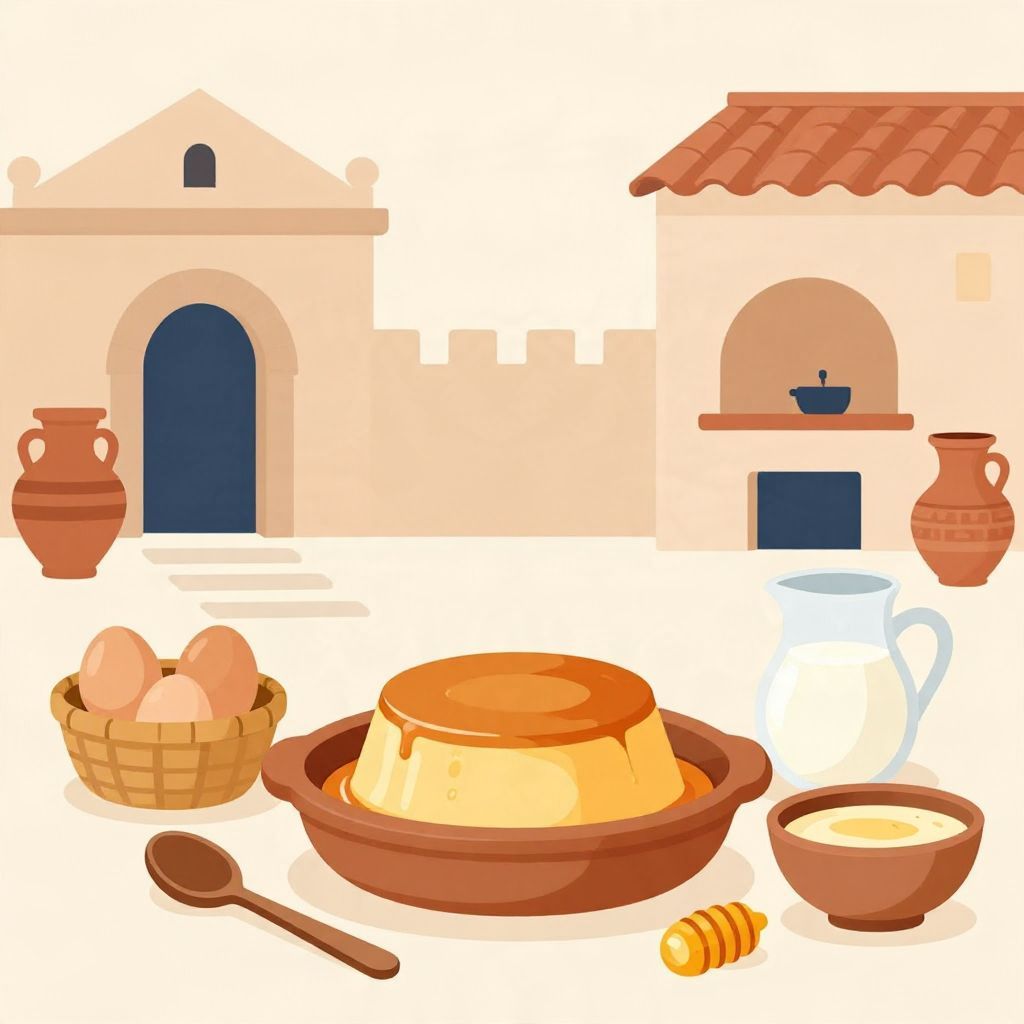
Where did flan originate? The short answer is that flan did not begin in one single place at one single moment. Its history stretches back to the Roman Empire, where early custard-like dishes were made with eggs and milk, and it later took recognizable form in medieval Europe, especially in Spain and France.
What many people call flan today is the result of centuries of culinary change. The dessert traveled through empires, adapted to local ingredients, and eventually became especially associated with Spanish and Latin American cooking.
Where did flan originate?
Flan originated in ancient Rome as a broad family of egg-based dishes and later developed into the sweet caramel custard most people recognize in medieval and early modern Europe. The dessert’s strongest historical roots are usually traced through Roman, Spanish, and French culinary traditions, rather than to one single inventor or city.
The ancient roots of flan
To understand where flan came from, it helps to begin with the Roman world. The Romans prepared many egg-thickened dishes, both savory and sweet, and they helped spread these recipes across Europe as the empire expanded. These early preparations were not modern flan exactly, but they established the basic idea of a baked custard.
Roman custards and early egg dishes
Roman cookery included mixtures of eggs, milk, and honey, often baked or gently cooked. These dishes were practical because eggs thickened liquids naturally, and milk was widely available in rural and urban settings. Over time, this technique became part of the culinary inheritance of Europe after Rome’s political power declined.
The word flan itself is not Roman in origin in the modern sense. The term came later through medieval European languages, but the cooking method behind it—using eggs to set a custard—has much older roots. In historical terms, the dish is best understood as a descendant of Roman culinary practice, not a direct Roman recipe copied unchanged through the centuries.
How medieval Europe shaped flan
Flan became more recognizable in medieval Europe, when cooks in monasteries, noble households, and towns refined custard dishes and pastry shells. During this period, European cuisine absorbed older Roman techniques and combined them with new ingredients, trade goods, and regional tastes. This is when flan began to resemble both a dessert and, in some cases, a savory dish.
Spain and France in the development of flan
Spain and France are especially important in the history of flan. In medieval Spain, egg-based dishes were common in both Muslim and Christian culinary cultures, and the Iberian Peninsula became a major meeting place for food traditions from the Mediterranean and the Islamic world. French cooks, meanwhile, developed many custard and pastry preparations that helped define later European dessert culture.
In these regions, flan was not always the sweet caramel dessert known today. Some versions were savory, filled with meat, cheese, or vegetables. Others were sweetened with honey or sugar as those ingredients became more available. The modern dessert version emerged gradually, especially as sugar became more common in elite cooking.
The role of sugar and caramel
One of the most familiar features of modern flan is its caramel topping. That detail is historically important because caramelization became more common only after sugar was more widely imported, refined, and used in European kitchens. As sugar became cheaper and more available, cooks experimented with browning it to create a glossy sauce that complemented the soft custard beneath.
This means the classic caramel flan is not simply an ancient Roman dessert preserved intact. It is a later European development built on older custard traditions. The caramel layer gave flan its distinctive identity and helped distinguish it from other baked custards, puddings, and tarts.
Why Spain is often linked to flan
Spain is often named as the country most closely associated with flan because Spanish cuisine preserved and popularized many custard desserts, especially after the Middle Ages. Spanish colonial expansion then carried the dish across the Atlantic and into the Americas, where it became deeply rooted in local food cultures.
Flan in the Spanish world
In Spain, flan became a familiar dessert in households and restaurants, especially in forms made with eggs, milk, sugar, and caramel. Spanish cooks also influenced how the dish was named and served. Over time, the Spanish word flan became attached to a broad category of custard desserts, even when recipes varied by region.
It is important, however, not to confuse cultural association with a single point of invention. Spain did not “invent” custard from nothing. Rather, Spanish cuisine helped standardize and popularize a version of flan that became influential worldwide.
Flan in Latin America
Today, many people think of flan as a Latin American dessert, and that association is historically understandable. Spanish colonization brought European ingredients, techniques, and recipe traditions to the Americas, where they mixed with local foodways and new regional preferences. The result was a wide family of flans across Mexico, the Caribbean, Central America, and South America.
Colonial transmission and adaptation
After the Spanish Empire expanded into the Americas, flan traveled with settlers, clergy, and cooks. In colonial kitchens, it adapted to available ingredients such as local milk, eggs, vanilla, coconut, and condensed milk in later periods. This is why flan today can vary so much from place to place while still retaining its basic custard-and-caramel structure.
In many Latin American countries, flan became a standard dessert for family meals, celebrations, and restaurant menus. Its popularity was strengthened by the fact that its ingredients were relatively simple and its texture felt both elegant and comforting. Over time, it became a dish with deep cultural meaning rather than merely a borrowed European recipe.
What flan originally was, and what it became
Historically, flan has meant different things at different times. In some periods, it referred to a pastry or tart; in others, to a custard baked in a mold. The modern dessert version is only one stage in a longer history. That is why the question “Where did flan originate?” has more than one valid answer depending on how narrowly the word is defined.
Three stages in flan’s history
- Roman foundations: egg-and-milk dishes established the culinary principle of a baked custard.
- Medieval European development: Spain, France, and neighboring regions refined custards and pastry-based preparations.
- Modern global dessert: Spanish and Latin American traditions popularized caramel flan as it is known today.
This layered history explains why flan can be claimed by several culinary traditions at once. It is not a dish that appeared fully formed. Instead, it evolved through transmission, adaptation, and local innovation over many centuries.
Common myths about flan’s origin
Because flan is so widely loved, origin stories sometimes become simplified. One common myth is that flan was invented in a single country and then exported unchanged. Another is that the dessert has one clear “birthplace” that can be named without qualification. Historical evidence does not support either claim.
What historians can say with confidence
- Egg-based custards are ancient and were known in the Roman world.
- The modern dessert form developed in Europe over time, especially in Spain and France.
- Spanish colonial expansion helped spread flan across the Americas.
- Regional variations emerged as the recipe adapted to local ingredients and tastes.
What historians cannot say with equal confidence is that one person, one kitchen, or one exact year created flan. The dish belongs to a long culinary tradition rather than a single moment of invention.
Why flan’s origin matters
Flan’s history shows how food moves across borders and changes with each new culture that adopts it. A simple custard can carry the imprint of empire, trade, religion, migration, and everyday household cooking. That is part of what makes flan historically interesting: it is both ordinary and deeply global.
Its journey from Roman kitchens to medieval Europe and then to Latin America reflects a larger pattern in food history. Recipes survive not because they remain fixed, but because people keep reworking them. Flan endured by being flexible enough to fit different societies while keeping its essential identity.
So, where did flan originate? Historically, its deepest roots lie in ancient Roman custard-making, but the dessert we recognize today was shaped most strongly in medieval Spain and France and later spread widely through the Spanish-speaking world. For more on food and cultural origins, you might also enjoy reading about where gin came from and where Wawa originated.