
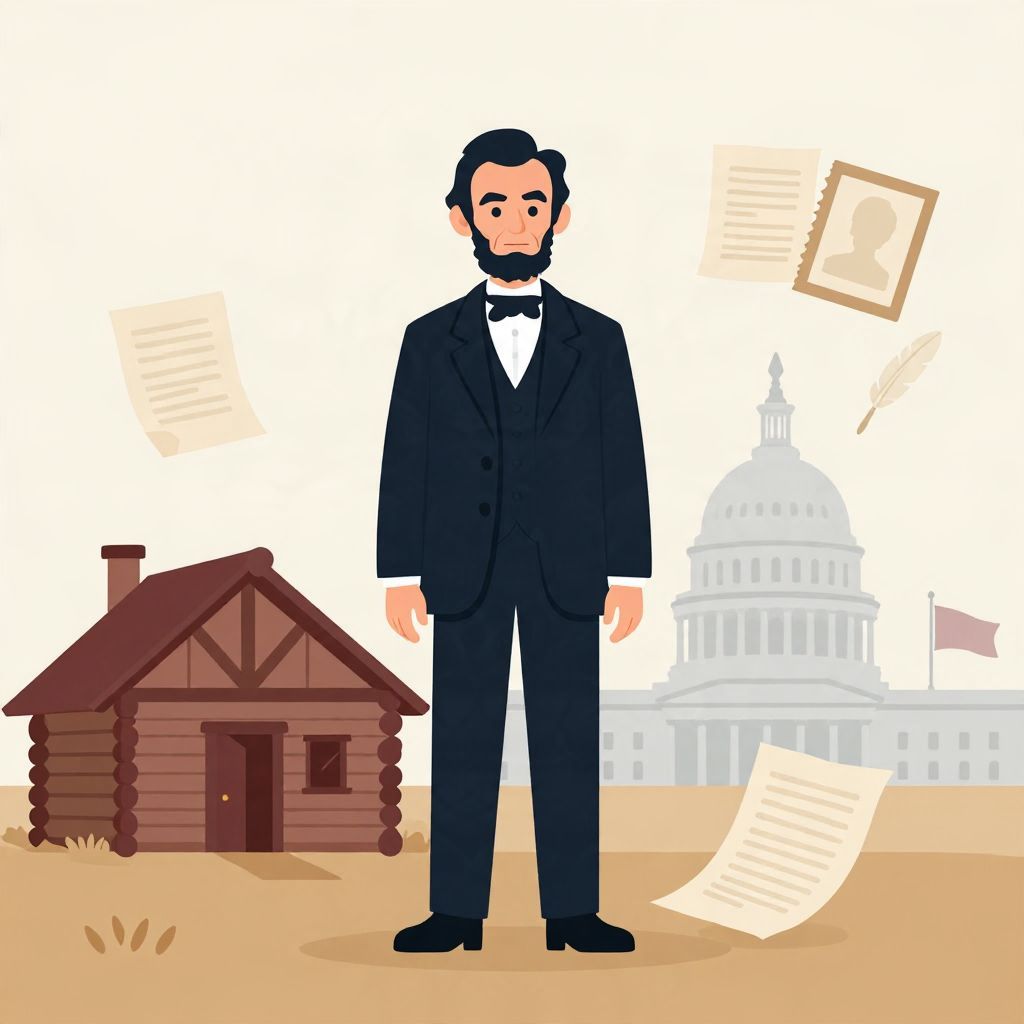
Was Abraham Lincoln Black? It’s a question that appears in internet searches, classroom debates, and family conversations, often because Lincoln’s image has been used in jokes, myths, and political arguments. The short historical answer is no: Abraham Lincoln was not Black, and there is no credible evidence that he identified as Black or had Black ancestry in the sense meant by the question.
What makes the question worth asking, however, is that it opens a larger historical discussion about race, identity, rumor, and the way famous people are remembered. Lincoln lived in a deeply racist 19th-century United States, where racial categories were socially powerful but also inconsistently defined. Understanding the evidence helps explain both who Lincoln was and why the myth persists.
Was Abraham Lincoln Black?
No. Abraham Lincoln was a white American of English and Scotch-Irish ancestry, born in Kentucky in 1809 and raised in frontier Indiana and Illinois. He never presented himself as Black, and the historical record does not support claims that he was African American or that he had hidden Black heritage.
What the historical evidence says about Lincoln’s ancestry
Lincoln’s family background is well documented. His father, Thomas Lincoln, and mother, Nancy Hanks Lincoln, were both white settlers from families rooted in colonial-era Anglo-American migration. Genealogical records, family histories, and contemporaneous accounts place Lincoln within the white rural population of the early United States, not within a Black lineage.
His family background
Lincoln was born on February 12, 1809, in Hardin County, Kentucky, in a slaveholding state. His parents were poor frontier farmers, not members of any documented Black community. The Lincolns later moved first to Indiana and then to Illinois, where Abraham Lincoln built his legal and political career.
Why ancestry matters here
In historical terms, “Black” usually refers to African descent and to the social category formed around that ancestry. Nothing in the reliable evidence suggests Lincoln had African ancestry. Claims to the contrary generally rely on rumor, symbolic interpretation, or modern internet speculation rather than primary sources.
Why do some people ask whether Abraham Lincoln was Black?
The question often comes from confusion between symbolism and biography. Lincoln became the president who issued the Emancipation Proclamation, helped preserve the Union, and became a central figure in the long struggle against slavery. Because of that legacy, some people associate him strongly with Black freedom and Black history, even though he was not Black himself.
Lincoln and emancipation
Lincoln’s role in ending slavery in the United States is historically significant, but it does not change his racial identity. He was a white politician who evolved over time in his views on slavery and race. Early in his career, like many white Americans of his era, he held views that were limited by racial prejudice. Later, as president during the Civil War, he came to support emancipation as a war measure and as a moral and political necessity.
The power of public memory
Famous historical figures often become symbols larger than their actual lives. Lincoln is remembered as the “Great Emancipator,” a title that reflects his importance in the destruction of slavery. Over time, symbolic admiration can blur into mythmaking, and myths can lead people to ask whether the person behind the symbol was something other than the historical record shows.
Did Lincoln ever claim to be Black or have Black ancestry?
There is no credible evidence that Abraham Lincoln ever claimed to be Black or that he concealed Black ancestry. No reliable historical source supports the idea that he identified as African American, multiracial in the modern sense, or descended from a Black family line.
What historians rely on
Historians study census records, family documents, letters, legal papers, portraits, memoirs, and newspaper coverage. In Lincoln’s case, these sources consistently place him within the white population of his time. While the 19th century used racial language differently than today, the evidence still does not support the claim that Lincoln was Black.
Why unsupported claims spread
Internet rumors can spread because they are provocative and easy to repeat. Some people may share the claim as a joke, a political statement, or a way to challenge familiar narratives. But historical accuracy requires more than a surprising idea; it requires evidence. In Lincoln’s case, the evidence points firmly in the opposite direction.
Lincoln’s views on race: complicated, not modern
To understand Lincoln historically, it is important not to project modern racial politics onto him. He was not an egalitarian in the 21st-century sense, and he did not begin his career as a racial radical. Like many white Americans of his generation, he often accepted assumptions about white superiority that are offensive today.
His political evolution
Lincoln opposed the expansion of slavery into new territories, but that was not the same as endorsing full racial equality. During the 1850s and early 1860s, he sometimes supported colonization schemes that imagined freed Black Americans leaving the United States. Those ideas reflected the racism of the period, even as his policies moved the nation toward emancipation.
Emancipation and its limits
The Emancipation Proclamation of 1863 did not free all enslaved people immediately everywhere in the United States. It applied to areas in rebellion against the Union and was a wartime measure. The Thirteenth Amendment, ratified in 1865 after Lincoln’s death, abolished slavery nationally. Lincoln’s leadership mattered enormously, but his record should be understood in context rather than simplified into a modern identity claim.
How race was understood in Lincoln’s time
Race in the 19th-century United States was a legal, social, and political system, not merely a matter of personal identity. People were classified by ancestry, appearance, law, and custom. These categories were often inconsistent and deeply discriminatory, but they still did not make Lincoln Black by any historical standard.
White, Black, enslaved, and free
In Lincoln’s lifetime, “Black” usually referred to people of African descent, whether enslaved or free. Enslaved people were denied rights on the basis of race, and free Black Americans faced severe discrimination. Lincoln, by contrast, was born into a white family and moved through the world as a white man in a white-dominated political system.
Why the distinction matters
Historical accuracy is important because race shaped access to power, law, and opportunity. Calling Lincoln Black without evidence distorts both his biography and the history of African Americans, whose experiences were fundamentally different from his. It also obscures the real struggles of Black abolitionists, soldiers, writers, and activists who fought slavery and racism directly.
Popular myths and mistaken claims about Lincoln
Several myths circulate about Lincoln, and they often get blended together. Some are harmless exaggerations; others are attempts to rewrite history. Sorting them out helps separate evidence from folklore.
- Myth: Lincoln was secretly Black.
Reality: No reliable evidence supports this. - Myth: Lincoln was a modern racial egalitarian from the start.
Reality: His views changed over time, and he remained limited by the racial assumptions of his era. - Myth: Because Lincoln freed the slaves, his own race is somehow open to debate.
Reality: His political legacy and his ancestry are separate questions.
Why the question still matters today
Questions like “Is Abraham Lincoln Black?” reveal how history is used in public culture. People often ask such questions not only to learn facts, but also to test assumptions about race, heroism, and national memory. In that sense, the question is historically useful even though the answer is straightforward.
History versus symbolism
Lincoln’s image has been used by many groups for different purposes: Union nationalists, civil rights advocates, school textbooks, political campaigns, and popular culture. Symbolic use can be powerful, but it should not replace evidence. The historical Lincoln was a white man whose presidency transformed the nation, even though his personal beliefs were shaped by the prejudices of his century.
Respecting Black history accurately
It is possible to honor Lincoln’s role in emancipation without misidentifying him. Black history in the United States is rich, complex, and rooted in the experiences of enslaved and free African Americans, abolitionists, soldiers, and reformers. Their history does not need Lincoln to be Black in order to matter.
Conclusion: the historical answer
Abraham Lincoln was not Black. He was a white 19th-century American politician whose ancestry, life, and public identity are well documented. The myth persists because Lincoln is so closely associated with emancipation and Black freedom, but the evidence does not support the claim. If you want to explore how race shapes historical memory, you may also be interested in related discussions such as why people ask whether Michael Jackson was white or whether Babe Ruth was Black.