
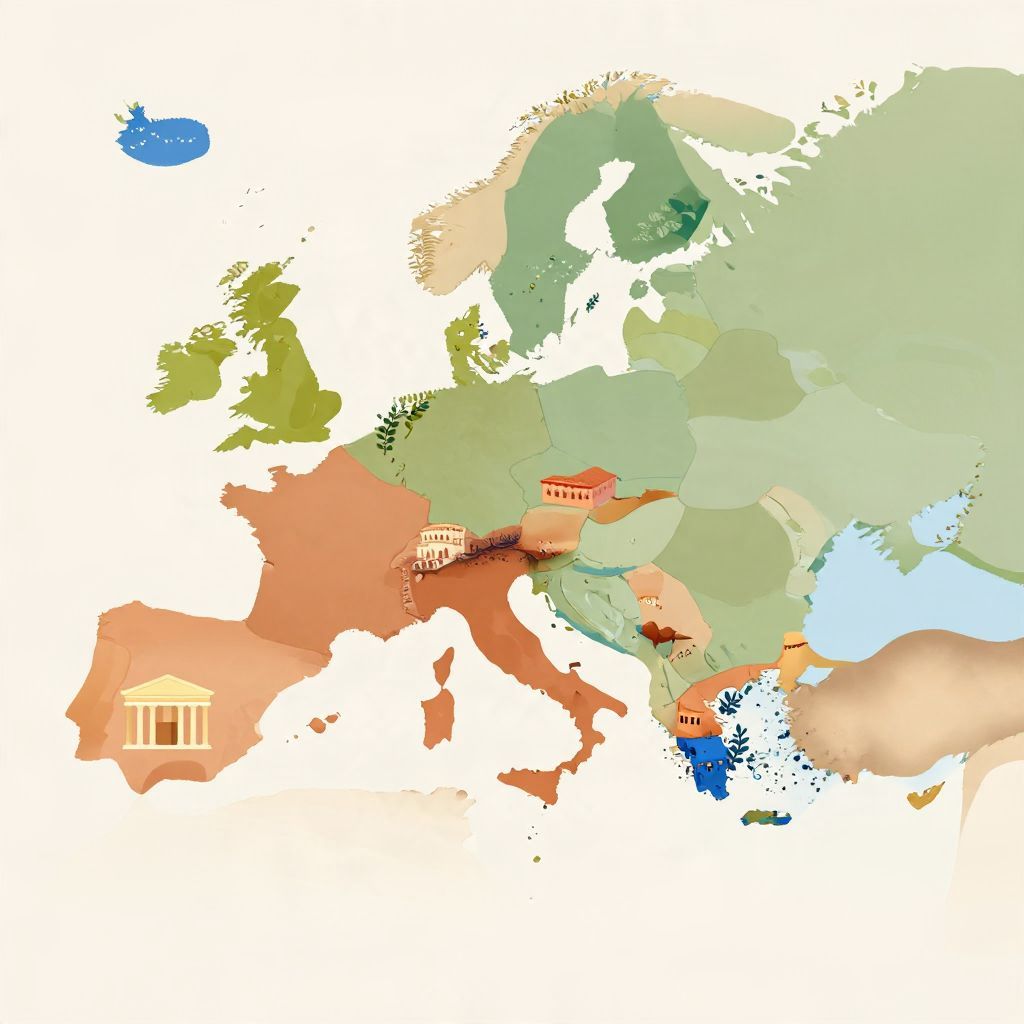
Is Greece in Italy? The short answer is no: Greece and Italy are separate countries in southern Europe, divided by the Ionian and Adriatic seas. The confusion is understandable because the two regions have been closely connected for thousands of years through trade, colonization, warfare, and shared Mediterranean culture.
Historically, parts of southern Italy were once deeply “Greek” in language and culture, which is one reason the question still comes up. But in modern geography and in historical terms, Greece is not part of Italy, and Italy is not part of Greece.
Is Greece in Italy?
No. Greece is an independent country in southeastern Europe, while Italy is a separate country on the Italian peninsula. They are neighbors across the Ionian Sea, but they have distinct borders, governments, and national histories. The confusion comes from ancient Greek settlements in southern Italy and Sicily, not from Greece being located inside Italy.
Why people confuse Greece and Italy
The mix-up usually comes from the ancient Mediterranean world, where Greek and Italian history overlapped constantly. Greek merchants, settlers, and armies moved across the sea long before modern national borders existed. In some periods, Greek language and customs were visible in parts of what is now Italy, especially in the south.
The “Greek” south of Italy
From about the 8th century BCE onward, Greeks founded colonies in southern Italy and Sicily. This region became known to later Romans as Magna Graecia, or “Greater Greece.” Cities such as Taras (modern Taranto), Sybaris, Croton, and Naples had strong Greek roots. That ancient history still influences how people think about the map today.
Shared Mediterranean history
Italy and Greece also share a broader cultural heritage. Ancient Rome borrowed heavily from Greek art, religion, literature, and philosophy. Later, both regions became part of the Christian Mediterranean world and were shaped by Byzantine, Ottoman, and Western European influences. These long connections can blur the line between cultural influence and political geography.
What the historical evidence shows
Historical evidence clearly separates Greece and Italy as different places. In antiquity, they were distinct regions with their own peoples, city-states, and political systems. Greek colonies in Italy were settlements, not proof that Greece itself was located in Italy. Later, Roman rule united much of the Mediterranean, but even then Greece and Italy remained different provinces and regions.
Ancient Greece and ancient Italy were not the same place
Ancient Greece developed around the Aegean world, including the Greek mainland, the islands, and coastal settlements in Asia Minor. Ancient Italy referred to the Italian peninsula and nearby islands. The two regions interacted constantly, but they were geographically separate and politically distinct long before the modern nations of Greece and Italy existed.
Roman conquest changed power, not geography
Rome conquered Greece in the 2nd century BCE, and Greek culture became deeply embedded in Roman life. But Roman control did not move Greece into Italy. Instead, both regions became parts of a wider Roman world. After the fall of the Western Roman Empire, the eastern Greek-speaking Roman Empire—what historians call the Byzantine Empire—continued to center on Constantinople, not on Italy.
A brief timeline of Greek and Italian connections
The relationship between Greece and Italy is best understood as a long sequence of contact, influence, and political change. Here is a simplified chronology:
- 8th–6th centuries BCE: Greek colonists establish settlements in southern Italy and Sicily.
- 5th–3rd centuries BCE: Greek and Italic communities compete, trade, and sometimes ally with one another.
- 3rd–2nd centuries BCE: Rome expands across Italy and then conquers the Greek world.
- 1st century BCE–5th century CE: Greece and Italy are both part of the Roman Empire.
- Byzantine era: Greek language and Eastern Roman influence remain strong in parts of southern Italy.
- 19th century: Modern nation-states of Italy and Greece emerge through unification and independence movements.
How ancient Greek settlement in Italy worked
Greek colonization in Italy was not a single invasion or a single empire. It was a series of settlements founded by different Greek city-states for trade, farming, and strategic advantage. Colonists brought their language, religious practices, and urban institutions with them, but they did not erase the local populations. The result was a mixed cultural landscape.
Magna Graecia and its legacy
Magna Graecia became famous in antiquity for wealth, learning, and artistic production. Some southern Italian cities were so strongly influenced by Greek culture that they remained centers of Greek identity for centuries. Even today, small communities in parts of Calabria and Apulia preserve traces of Greek linguistic and cultural heritage, though this does not make them part of Greece.
Sicily and the wider Greek world
Sicily was also a major center of Greek colonization. Cities like Syracuse became powerful and influential in their own right. The island’s history shows how fluid the ancient Mediterranean could be: Greek, Phoenician, Carthaginian, Roman, Byzantine, Arab, Norman, and Italian layers all shaped the region over time.
Modern Greece and modern Italy are separate nations
In the modern era, Greece and Italy are sovereign states with their own borders and political histories. Italy was unified in the 19th century, mainly in the 1860s. Greece won independence from the Ottoman Empire in the 1820s and was internationally recognized in the 1830s. Their modern national identities developed separately, even though both drew on ancient classical heritage.
Modern borders
Today, Greece lies southeast of Italy across the Ionian Sea. The two countries are separated by water, not by an internal border. A map of Europe places Italy on the central Mediterranean peninsula and Greece farther east, on the Balkan peninsula and its many islands.
Shared but distinct national stories
Both countries celebrate ancient civilization as part of their national memory, but in different ways. Italy looks to Rome and the Renaissance, while Greece emphasizes ancient Athens, Sparta, the Hellenistic world, and the struggle for independence. Their histories intersect, but they are not interchangeable.
Why the question matters historically
Asking whether Greece is in Italy is more than a geography quiz. It highlights how ancient history can shape modern misunderstandings. People often confuse cultural influence with territorial identity. Because Greek civilization left such a strong mark on southern Italy, it is easy to assume the regions were once the same place. In reality, they were connected neighbors with long, overlapping histories.
Culture is not the same as territory
A region can be heavily influenced by another civilization without becoming part of it. That was true in the ancient Mediterranean, where language, religion, trade, and art crossed sea routes constantly. The Greek presence in Italy was real and important, but it did not erase the distinction between Greece and Italy as places.
How historians think about the Mediterranean
Historians often describe the ancient Mediterranean as a network rather than a set of isolated nations. People moved, traded, fought, and settled across the sea. This approach helps explain why Greek temples can stand in Italy, Roman ruins can be found in Greece, and both countries still share many elements of classical heritage.
So, is Greece in Italy?
No. Greece is not in Italy, and Italy is not in Greece. They are separate countries with separate histories, even though they have been deeply connected since antiquity. The ancient Greek presence in southern Italy explains the confusion, but it does not change the map. Greece and Italy are neighbors, not one and the same.
Understanding that distinction helps make sense of the ancient Mediterranean world and the modern nations that grew out of it. If you are interested in other geography-and-history mix-ups, you may also like Is Hong Kong in Japan? and Is Confederate Money Worth Anything?