
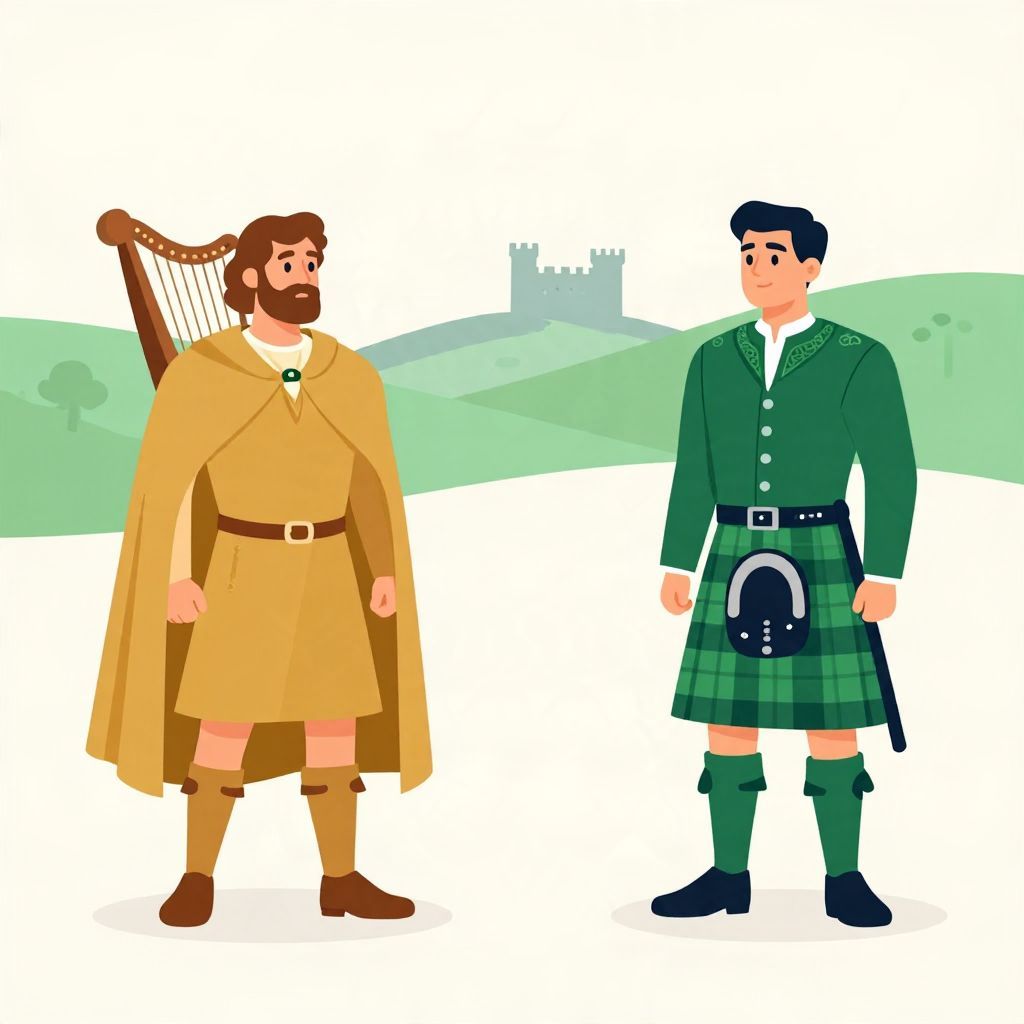
Do Irish wear kilts? The short historical answer is yes, some do—but kilts are not originally the everyday national dress of Ireland in the way they are often imagined for Scotland. The modern Irish kilt is a later cultural symbol, especially associated with nationalism, ceremonial wear, and Irish identity rather than a long, universal medieval tradition.
To understand why, it helps to separate ancient Irish clothing, modern “Irish” kilts, and the much older Scottish kilt tradition. The answer is rooted in history, revival movements, and the way national dress was created and re-created over time.
Do Irish Wear Kilts?
Yes, Irish people do wear kilts, especially for formal occasions, sports, dance, and cultural events. However, the kilt is not the original everyday garment of most Irish people. The modern Irish kilt is largely a 19th- and 20th-century expression of Irish identity, while the best-documented long-standing kilt tradition developed in Scotland.
What Irish Clothing Looked Like Before the Modern Kilt
In early and medieval Ireland, people wore clothing suited to climate, status, and local custom rather than a standardized “national costume.” Historical evidence points to tunics, cloaks, belts, and woolen garments as common forms of dress. Elite clothing could be richly colored and decorated, but there was no single garment that functioned as a universal Irish national dress in the modern sense.
Cloths, cloaks, and social rank
Irish dress in the early medieval period reflected a society organized by rank. Cloaks were especially important in Gaelic culture, and textiles could signal wealth and status. The famous image of the Celtic world as one of tartans and kilts is much more strongly associated with later romantic nationalism than with the clothing of early Ireland.
The léine and other Gaelic garments
One garment often mentioned in discussions of Irish historical dress is the léine, a long tunic worn by men and sometimes women in Gaelic Ireland and Scotland. It was not a kilt. It was part of a broader medieval clothing tradition that changed over time and was influenced by wider European styles.
Where the Irish Kilt Came From
The Irish kilt, as most people recognize it today, is a relatively modern development. It emerged in the context of cultural revival, political nationalism, and the growing interest in “traditional” ethnic dress during the 19th century. In other words, the Irish kilt is historically real, but it is not ancient in the same way many people assume.
19th-century revival and identity
During the 1800s, many Europeans became interested in defining national cultures through language, costume, music, and folklore. In Ireland, this period included efforts to revive Gaelic identity and distinguish Irish culture from British rule. Clothing became one way to express that identity, and the kilt was adapted into Irish ceremonial wear.
Why the kilt appealed in Ireland
The kilt carried several meanings that made it attractive. It suggested Celtic heritage, linked wearers to a heroic past, and provided a visually striking alternative to ordinary Victorian dress. For some Irish nationalists, wearing a kilt was not about claiming an uninterrupted ancient Irish custom; it was about creating a visible symbol of Irishness in the modern era.
How Irish Kilts Differ From Scottish Kilts
Irish and Scottish kilts can look similar, but they are not identical in cultural meaning. The Scottish kilt has a much deeper association with Highland identity, clan tartans, and a longer documented history. Irish kilts are often worn in solid colors or with tartans associated with counties, families, or organizations, and they developed later as a distinct expression of Irish identity.
Tartan and symbolism
In Scotland, tartan became strongly tied to clan and regional identity, especially in the modern period. In Ireland, tartans are often used more flexibly. Some Irish kilts feature county tartans, while others use saffron or other colors associated with Irish symbolism. The use of tartan in Ireland is meaningful, but it does not mirror Scottish practice exactly.
The saffron kilt
One of the best-known Irish styles is the saffron kilt, usually a bright yellow-orange color. This style became especially associated with Irish ceremonial and nationalist identity. It is often worn by pipe bands, dancers, and formal groups. The color itself has symbolic power, but the garment is still a modern cultural form rather than a direct survival from ancient Ireland.
Why People Think Kilts Are “Scottish Only”
Many people assume kilts are exclusively Scottish because Scotland has the strongest and most famous kilt tradition. That impression is understandable. Scottish Highland dress was more widely documented, more heavily romanticized, and more internationally marketed in the 18th and 19th centuries. Irish kilt traditions exist, but they were less central to the popular global image of Irish culture.
Romantic nationalism and public image
In the 18th and 19th centuries, writers, artists, and political movements across the British Isles helped turn older regional clothing into symbols of national character. Scotland’s kilt became a powerful emblem of Highland identity. Ireland, meanwhile, developed its own symbols through music, language revival, political movements, and selected forms of dress. The result is that the kilt became more visibly “Scottish” in popular memory, even though Irish versions also developed.
Colonial and political context
Irish cultural symbols often took shape in a period marked by British rule, land conflict, famine, migration, and political struggle. In that setting, adopting or adapting traditional-looking dress could carry political meaning. A kilt worn in Ireland was not merely clothing; it could signal cultural pride, resistance, or participation in a broader Gaelic revival.
Who Wears Irish Kilts Today?
Today, Irish kilts are worn by a range of people and groups. They appear in weddings, graduations, parades, pipe bands, dance performances, and heritage events. Some wear them as a family or county tradition, while others wear them simply as formal dress with Irish cultural associations. They are especially visible in diaspora communities in North America, Australia, and elsewhere.
Common modern settings
- Weddings and formal celebrations
- Pipe bands and musical performances
- Irish dance and cultural festivals
- Parades and heritage events
- Diaspora ceremonies celebrating Irish ancestry
Not everyday wear
For most Irish people, kilts are not ordinary daily clothing. They are ceremonial, festive, or symbolic. In that sense, the modern Irish kilt functions much like other national or heritage garments around the world: it is worn selectively to express identity, not because it remains the standard everyday outfit of the population.
Did Ancient Irish People Wear Kilts?
No clear evidence supports the idea that ancient Irish people wore kilts in the modern sense. This is one of the most common misunderstandings. Early Irish clothing included tunics, cloaks, and other garments, but the tailored, pleated kilt associated with modern Celtic dress is a later development. Claims that ancient Ireland had the same kilt tradition as modern Scotland are not well supported by historical evidence.
What evidence can and cannot show
Surviving texts, illustrations, and later reconstructions can tell us a great deal about historical dress, but they do not show a continuous ancient Irish kilt tradition. Historians are careful here because costume history is often shaped by later imagination. When modern people speak of “ancient Irish kilts,” they are usually referring to romantic reconstructions rather than proven historical continuity.
Folklore versus history
National dress often accumulates myths. A garment may come to seem ancient because it feels traditional, even if its present form is recent. The Irish kilt is a good example: it is culturally meaningful, but its symbolic age is greater than its documented age.
Why the Question Still Matters
Asking whether Irish people wear kilts opens a larger historical issue: how nations create visible symbols of identity. Clothing is never just clothing. It can express class, region, politics, religion, memory, and belonging. The Irish kilt shows how a community can adopt and reshape a garment to fit modern identity needs, even if that garment was not originally central to its older dress traditions.
Identity, heritage, and reinvention
Irish culture has many layers, from Gaelic language and medieval customs to modern nationalism and diaspora identity. The kilt belongs to that later layer. It is meaningful because people made it meaningful. That does not make it fake; it makes it historically interesting as a product of cultural reinvention.
Conclusion
So, do Irish wear kilts? Yes, they do—but mostly as a modern ceremonial and cultural expression rather than as an ancient, everyday Irish tradition. The Irish kilt is part of the broader history of nationalism, heritage, and identity-making in the 19th and 20th centuries. For more on the cultural background, see where Irish people are from and how that compares with Scottish cultural identity.